Advertisements
Advertisements
प्रश्न
Derive the expression for the torque acting on an electric dipole, when it is held in a uniform electric field. identify the orientation of the dipole in the electric field, in which it attains a stable equilibrium.
Advertisements
उत्तर
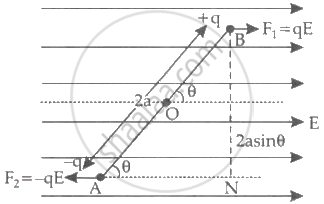
Force acting on −q is −qE.
Force acting on +q is qE.
These two forces are equal and opposite to each other. Hence, a torque on the dipole is developed.
Torque = Force × perpendicular distance between the forces
Or, τ = qE × 2 a sin θ
Or, τ = (q × 2a) E sin θ
∴ τ = PE sin θ
Where P is the dipole moment.
Dipole will attain stable equilibrium when it is oriented along the direction of electric field.
संबंधित प्रश्न
An electric dipole is placed in a uniform electric field. The net electric force on the dipole
Maximum torque acting on an electric dipole of moment 3×10-29 Cm in a uniform electric field E is 6 × 10-25 Nm. Find E.
A short bar magnet of magnetic moment m = 0.32 J T–1 is placed in a uniform magnetic field of 0.15 T. If the bar is free to rotate in the plane of the field, which orientation would correspond to its
- stable, and
- unstable equilibrium?
What is the potential energy of the magnet in each case?
If the solenoid is free to turn about the vertical direction and a uniform horizontal magnetic field of 0.25 T is applied, what is the magnitude of torque on the solenoid when its axis makes an angle of 30° with the direction of applied field?
Assertion: The poles of magnet can not be separated by breaking into two pieces.
Reason: The magnetic moment will be reduced to half when a magnet is broken into two equal pieces.
When an electric dipole is placed in a uniform electric field, what is the net force acting on the dipole?
Using the right-hand screw rule, determine the direction of torque when a dipole moment \[\vec{p}\] is rotated toward an electric field \[\vec{E}\].
At what angle θ between the dipole moment and the electric field is the torque on the dipole maximum?
Which equilibrium position of a dipole in a uniform electric field is stable?
What real-world phenomenon demonstrates the behavior of a dipole in a non-uniform electric field?
