Advertisements
Advertisements
प्रश्न
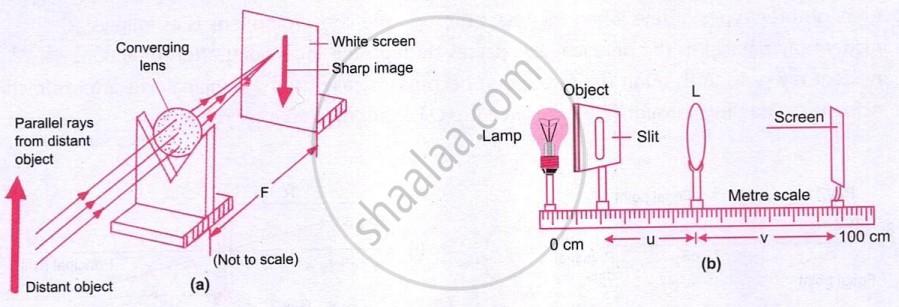
To determine the focal length of a convex lens.
Arrange the apparatus as shown in Fig. (a). Choose a distant object (say a tree) outside the laboratory so that light rays from it may be regarded as a parallel beam of light. Adjust the position of the white screen until a sharp image (inverted and diminished) is formed on the screen. Measure the distance between the optical centre and the image (screen). This will be the approximate focal length ‘f’ of the lens. Repeat the experiment and find the average value for ‘f’.
Advertisements
उत्तर
Aim: To determine the approximate focal length of a convex lens.
Principle: A distant object sends nearly parallel rays to a convex lens. The lens refracts these rays so that they meet at the second principal focus. Hence, the distance between the optical centre and the sharp screen image gives the focal length.
Procedure:
- Face the convex lens toward a distant object such as a tree.
- Place a white screen behind the lens.
- Move the screen until a sharp, inverted and diminished image is formed on it.
- Measure the distance between the optical centre of the lens and the screen; this is the approximate focal length.
- Repeat the measurement and find the average value.
Lens-formula explanation: \[ \frac{1}{v}+\frac{1}{u}=\frac{1}{f} \] For a distant object, the object distance is very large, so: \[ u \to \infty,\quad \frac{1}{u}=0 \quad\Rightarrow\quad v=f \] The measured screen distance corresponds to the image distance in the formula above.
Average calculation: \[f_{\text{average}}=\frac{f_1+f_2+\cdots+f_n}{n}\]
Precautions:
- Use a bright distant object so that incident rays are nearly parallel.
- Keep the lens and screen perpendicular to the principal axis.
- Measure from the optical centre, not from the edge of the lens.
Conclusion: The mean of the measured screen distances gives the approximate focal length of the convex lens.
