Advertisements
Advertisements
प्रश्न
The value of magnetic moment is zero in the case of antiferromagnetic substances because the domains:
(i) get oriented in the direction of the applied magnetic field.
(ii) get oriented opposite to the direction of the applied magnetic field.
(iii) are oppositely oriented with respect to each other without the application of magnetic field.
(iv) cancel out each other’s magnetic moment.
Advertisements
उत्तर
(iii) are oppositely oriented with respect to each other without the application of magnetic field.
(iv) cancel out each other’s magnetic moment.
Explanation:
In the case of antiferromagnetic substances, the magnetic moment becomes zero because the domains are oppositely oriented with respect to each other without the application of magnetic field which cancel out each other.
| Antiferromagnetic | This arises when net dipole is zero. This arises due to alignment of dipoles in equal and opposite direction. |
↑ ↓ ↑ ↓ ↑ ↓ Here dipoles |
MnO, MnO2, Mn2O, FeO, Fe2O3, NiO, Cr2O3, CoO, Co3O4 |
– |
APPEARS IN
संबंधित प्रश्न
What is ferromagnetism?
What type of magnetism is shown in the following alignment of magnetic moments?

What type of magnetism is shown by a substance if magnetic moments of domains are arranged in same direction?
Write the type of magnetism observed when the magnetic moments are oppositely aligned and cancel out each other.
Write the type of magnetism observed when the magnetic moments are aligned in parallel and anti-parallel directions in unequal numbers.
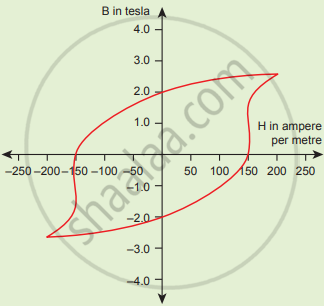
The BH curve for a ferromagnetic material is shown in the figure. The material is placed inside a long solenoid which contains 1000 turns/cm. The current that should be passed in the solenonid to demagnetize the ferromagnet completely is
What is magnetic susceptibility?
Compare dia, para and ferromagnetism.
Compare the properties of soft and hard ferromagnetic materials.
Example of ferromagnetic substance is ____________.
When heated to high temperature, ferromagnetic substance changes to ____________.
Which type of substances would make better permanent magnets?
Assertion: On heating ferromagnetic or ferrimagnetic substances, they become paramagnetic.
Reason: The electrons change their spin on heating.
Which of the following arrangements shows schematic alignment of magnetic moments of antiferromagnetic substances?
Which of the following statements is not true?
The heat of combustion of a substance is:
Magnetic materials used for making permanent magnets (P) and magnets in a transformer (T) have different properties of the following, which property best matches for the type of magnet required ?
The susceptibility of a paramagnetic material is 99. The permeability of the material in Wb/A-m is ______.
[permeability of the free space μ0 = 4π × 10-7 Wb/A - m]
The calculated spin only magnetic moment of Cr2+ ion is ______.
