Advertisements
Advertisements
प्रश्न
The transverse displacement of a string (clamped at its both ends) is given by y(x, t) = 0.06 sin (2πx/3) cos (120 πt). All the points on the string between two consecutive nodes vibrate with ______.
- same frequency
- same phase
- same energy
- different amplitude.
Advertisements
उत्तर
a, b and d
Explanation:
Given equation is `y(x, t) = 0.06 sin ((2pi)/3 x) cos (120 pit)`
Comparing with standard equation of stationary wave `y(x, t) = a sin(kx) cos(ωt)`
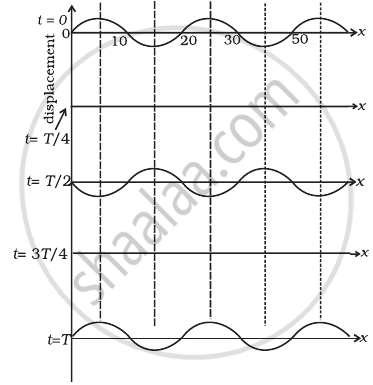
It is represented by the diagram,
Where N denotes nodes and A denotes antinodes.

a. Clearly, frequency is common for all the points.
b. Consider all the particles between two nodes they are having the same phase of (120 πt) at a given time.
c. and d. But are having different amplitudes of `0.06 sin ((2pi)/3 x)` and because of different amplitudes, they are having different energies.
APPEARS IN
संबंधित प्रश्न
A pipe 20 cm long is closed at one end. Which harmonic mode of the pipe is resonantly excited by a 430 Hz source? Will the same source be in resonance with the pipe if both ends are open? (Speed of sound in air is 340 m s–1).
Explain why (or how) In a sound wave, a displacement node is a pressure antinode and vice versa,
An open organ pipe of length L vibrates in its fundamental mode. The pressure variation is maximum
Two wires are kept tight between the same pair of supports. The tensions in the wires are in the ratio 2 : 1 the radii are in the ratio 3 : 1 and the densities are in the ratio 1 : 2. Find the ratio of their fundamental frequencies.
Water waves produced by a motor boat sailing in water are ______.
The displacement of a string is given by y (x, t) = 0.06 sin (2πx/3) cos (120 πt) where x and y are in m and t in s. The length of the string is 1.5 m and its mass is 3.0 × 10⁻² kg.
- It represents a progressive wave of frequency 60 Hz.
- It represents a stationary wave of frequency 60 Hz.
- It is the result of superposition of two waves of wavelength 3 m, frequency 60 Hz each travelling with a speed of 180 m/s in opposite direction.
- Amplitude of this wave is constant.
A pipe 20 cm long is closed at one end. Which harmonic mode of the pipe is resonantly excited by a source of 1237.5 Hz? (sound velocity in air = 330 ms–1)
The wave pattern on a stretched string is shown in figure. Interpret what kind of wave this is and find its wavelength.
A tuning fork vibrating with a frequency of 512 Hz is kept close to the open end of a tube filled with water (Figure). The water level in the tube is gradually lowered. When the water level is 17 cm below the open end, maximum intensity of sound is heard. If the room temperature is 20°C, calculate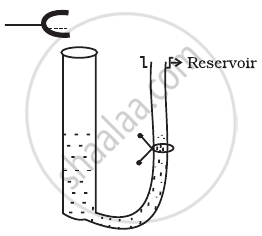
- speed of sound in air at room temperature
- speed of sound in air at 0°C
- if the water in the tube is replaced with mercury, will there be any difference in your observations?
Show that when a string fixed at its two ends vibrates in 1 loop, 2 loops, 3 loops and 4 loops, the frequencies are in the ratio 1:2:3:4.
Two identical strings X and Z made of same material have tension Tx and Tz in them If their fundamental frequencies are 450 Hz and 300 Hz, respectively, then the ratio `"T"_x/"T"_"z"` is ______.
Shown in the figure is rigid and uniform one meter long rod AB held in horizontal position by two strings tied to its ends and attached to the ceiling. The rod is of mass 'm' and has another weight of mass 2m hung at a distance of 75 cm from A. The tension in the string at A is :

Two travelling waves produce a standing wave represented by the equation. y = 1.0 mm cos (1.57 cm-1) x sin (78.5 s-1)t. The node closest to the origin in the region x > 0 will be at x = ______ cm.

A wire of length 2L is made by joining two wires A and B of the same length but different radii r and 2r, and made of the same material. It is vibrating at a frequency such that the joint of the two wires forms a node. If the number of antinodes in wire A is p and that in B is q then the ratio p : q is ______.
