Advertisements
Advertisements
प्रश्न
The Quit India Resolution in 1942 was one of the final calls given by Gandhi for the British to leave India. Moving towards Independence, Lord Mountbatten’s Plan was significant. In this context, answer the following:
State two reasons for the launching of the Quit India Movement.
Advertisements
उत्तर
Two reasons for launching the Quit India Movement:
(i) The resignation of the Congress Ministries: Congress had formed ministries in the United Provinces, Central Provinces, Orissa, Bihar, Madras and Bombay. Later, it also formed governments in Assam and North-West Frontier Province. The Congress leaders questioned as to how an enslaved nation could aid others in fighting a war. In protest against the decision of the government to join the Second World War and its refusal to liberate India, the Congress ministries resigned.
(ii) The August Offer: In the British Parliamentary elections in 1940, Winston Churchill became the Prime Minister of Britain. Under international compulsion, the British government made a new offer to the Congress known as the ‘August Offer’ on 8 August 1940. The Congress rejected the offer as too much constitutional independence was given to the minorities. The League also rejected the offer because it did not talk about the formation of the separate state of Pakistan.
APPEARS IN
संबंधित प्रश्न
Give any one proposal of Cripps Mission.
Name the ‘Mantra’, which was given by Gandhiji during Quit India Movement.
When and by whom was the August offer made?
Who was selected as the first satyagrahi during the Individual Satyagraha of 1940?
What were the circumstances during the Second World War which forced the National leaders to launch the Quit India Movement?
What were the repressive policies adopted by the Government to suppress the Quit India Movement?
State any two points to justify the impact of the movement.
In what way was the Quit India Movement different from earlier movements?
Which resolution was passed on 8th August, 1942 leading to a mass struggle on non-violent lines? State any two reasons behind the launching of this movement.
Answer the following: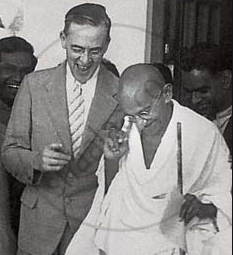
(i) Name the male personality in the picture with Gandhi given alongside.
(ii) Why Britain Prime Minister sent this gentleman to India?
