Advertisements
Advertisements
प्रश्न
The Quit India Resolution in 1942 was one of the final calls given by Gandhi for the British to leave India. Moving towards Independence, Lord Mountbatten’s Plan was significant. In this context, answer the following:
Give any three effects of the Quit India Movement launched by Gandhi in 1942 that was significant to the last phase of the National Movement of India.
Advertisements
उत्तर
Three effects of the Quit India Movement launched by Gandhi in 1942 which were significant to the last phase of the National Movement of India:
(i) Although the Movement was short-lived, the people developed greater ability to struggle and sacrifice.
(ii) It became evident that the British no longer would be able to rule India.
(iii) The Movement signified the mass uprising of the people. People from every state, class, caste, sex and creed participated in the Movement.
APPEARS IN
संबंधित प्रश्न
Why was the Government of India Act, 1935 passed?
Who was selected as the first satyagrahi during the Individual Satyagraha of 1940?
Why was the Cripps Mission rejected by the Mulsim League?
What was the proposal of Cripps Mission regarding the Princely states?
State any two important proposals of Crippse offer?
Name the leaders who played an important role during the Quit India Movement?
In the political scenario of 1939, important developments took place in India and abroad. In this context, mention the circumstances which led to the passage of the Act of 1935?
Which resolution was passed on 8th August, 1942 leading to a mass struggle on non-violent lines? State any two reasons behind the launching of this movement.
Answer the following: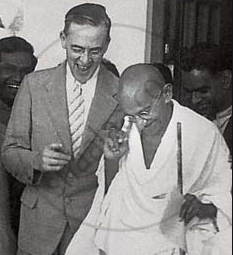
(i) Name the male personality in the picture with Gandhi given alongside.
(ii) Why Britain Prime Minister sent this gentleman to India?
Which of the following countries will NOT be part of this cartoon?