Advertisements
Advertisements
प्रश्न
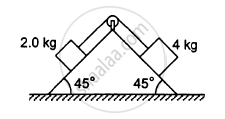
The pulley shown in the following figure has a radius 10 cm and moment of inertia 0⋅5 kg-m2about its axis. Assuming the inclined planes to be frictionless, calculate the acceleration of the 4⋅0 kg block.
Advertisements
उत्तर
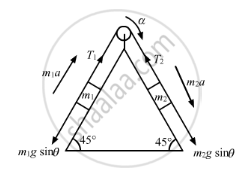
From the figure, we have
\[T_1 - m_1 g\sin\theta = m_1 a ..........(1)\]
\[ T_2 - T_1 = I\frac{a}{r^2} ........(2)\]
\[ m_2 g\sin\theta - T_2 = m_2 a ..........(3)\]
Adding equations (1) and (3), we get
\[m_2 g\sin\theta + \left( - T_2 + T_1 \right) - m_1 g\sin\theta = \left( m_1 + m_2 \right)a\]
\[\Rightarrow \left( m_2 - m_1 \right) g\sin\theta + \left( - \frac{I}{r^2} \right)a = ( m_1 + m_2 )a\]
\[ \Rightarrow \left( m_2 - m_1 \right) g\sin\theta = ( m_1 + m_2 )a + \left( \frac{I}{r^2} \right)a\]
\[ \Rightarrow a = \frac{\left( m_2 - m_1 \right)g\sin\theta}{\left( m_2 + m_1 + \frac{I}{r^2} \right)}\]
\[ = \frac{\left( 4 - 2 \right) \times 10 \times \left( 1\sqrt{2} \right)}{\left( 4 + 2 \right) + \left( 0 . 5/0 . 01 \right)}\]
\[ = \frac{\left( 2 \times 10 \times \frac{1}{\sqrt{2}} \right)}{\left( 6 + 50 \right)}\]
\[ = 0 . 248 = 0 . 25 m/ s^2\]
APPEARS IN
संबंधित प्रश्न
Torques of equal magnitude are applied to a hollow cylinder and a solid sphere, both having the same mass and radius. The cylinder is free to rotate about its standard axis of symmetry, and the sphere is free to rotate about an axis passing through its centre. Which of the two will acquire a greater angular speed after a given time?
A child stands at the centre of a turntable with his two arms outstretched. The turntable is set rotating with an angular speed of 40 rev/min. How much is the angular speed of the child if he folds his hands back and thereby reduces his moment of inertia to 2/5 times the initial value? Assume that the turntable rotates without friction.
Show that the child’s new kinetic energy of rotation is more than the initial kinetic energy of rotation. How do you account for this increase in kinetic energy?
A hoop of radius 2 m weighs 100 kg. It rolls along a horizontal floor so that its centre of mass has a speed of 20 cm/s. How much work has to be done to stop it?
Two discs of moments of inertia I1 and I2 about their respective axes (normal to the disc and passing through the centre), and rotating with angular speeds ω1 and ω2 are brought into contact face to face with their axes of rotation coincident. (a) What is the angular speed of the two-disc system? (b) Show that the kinetic energy of the combined system is less than the sum of the initial kinetic energies of the two discs. How do you account for this loss in energy? Take ω1 ≠ ω2.
The moment of inertia of a uniform semicircular wire of mass M and radius r about a line perpendicular to the plane of the wire through the centre is ___________ .
Let I1 an I2 be the moments of inertia of two bodies of identical geometrical shape, the first made of aluminium and the second of iron.
A body having its centre of mass at the origin has three of its particles at (a,0,0), (0,a,0), (0,0,a). The moments of inertia of the body about the X and Y axes are 0⋅20 kg-m2 each. The moment of inertia about the Z-axis
Let IA and IB be moments of inertia of a body about two axes A and B respectively. The axis A passes through the centre of mass of the body but B does not.
Suppose the smaller pulley of the previous problem has its radius 5⋅0 cm and moment of inertia 0⋅10 kg-m2. Find the tension in the part of the string joining the pulleys.
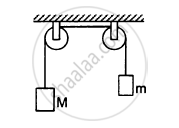
The pulleys shown in the following figure are identical, each having a radius R and moment of inertia I. Find the acceleration of the block M.
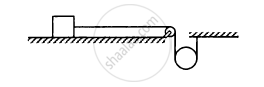
The descending pulley shown in the following figure has a radius 20 cm and moment of inertia 0⋅20 kg-m2. The fixed pulley is light and the horizontal plane frictionless. Find the acceleration of the block if its mass is 1⋅0 kg.
Four bodies of masses 2 kg, 3 kg, 4 kg and 5 kg are placed at points A, B, C, and D respectively of a square ABCD of side 1 metre. The radius of gyration of the system about an axis passing through A and perpendicular to plane is
A wheel of mass 15 kg has a moment of inertia of 200 kg-m2 about its own axis, the radius of gyration will be:
From a circular ring of mass ‘M’ and radius ‘R’ an arc corresponding to a 90° sector is removed. The moment of inertia of the remaining part of the ring about an axis passing through the centre of the ring and perpendicular to the plane of the ring is ‘K’ times ‘MR2’. Then the value of ‘K’ is ______.
Moment of inertia (M.I.) of four bodies, having same mass and radius, are reported as :
I1 = M.I. of thin circular ring about its diameter,
I2 = M.I. of circular disc about an axis perpendicular to disc and going through the centre,
I3 = M.I. of solid cylinder about its axis and
I4 = M.I. of solid sphere about its diameter.
Then -
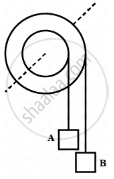
The figure shows a small wheel fixed coaxially on a bigger one of double the radius. The system rotates about the common axis. The strings supporting A and B do not slip on the wheels. If x and y be the distances travelled by A and B in the same time interval, then ______.
The moment of inertia of a thin rod about an axis passing through its mid point and perpendicular to the rod is 2400 g cm2. The length of the 400 g rod is nearly ______.
