Advertisements
Advertisements
प्रश्न
Solve the previous problem if the friction coefficient between the 2⋅0 kg block and the plane below it is 0⋅5 and the plane below the 4⋅0 kg block is frictionless.
Advertisements
उत्तर
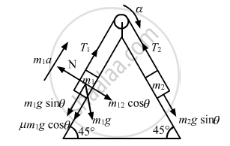
From the figure, we have
\[m_2 gsin\theta - T_2 = m_1 a..........(1)\]
\[ T_1 - \left( m_1 g\sin\theta + \mu m_1 g\cos \theta \right) = m_1 a ............(2)\]
\[ T_2 - T_1 = \frac{Ia}{r^2} .............(3)\]
Adding equations (1) and (2), we get
\[m_2 g\sin\theta - \left( m_1 g\sin\theta - \mu m_1 g\cos \theta \right) + \left( T_1 - T_2 \right) = m_1 a + m_2 a\]
\[m_2 g\sin\theta - \left( m_1 g\sin\theta + \mu m_1 g\cos \theta \right) - \frac{Ia}{r^2} = m_1 a + m_2 a\]
\[ m_2 g\sin\theta - \left( m_1 g\sin\theta + \mu m_1 g\cos \theta \right) = m_1 a + m_2 a + \frac{Ia}{r^2}\]
\[4 \times 9 . 8 \times \frac{1}{\sqrt{2}} - \left\{ 2 \times 9 . 8 \times \frac{1}{\sqrt{2}} + 0 . 5 \times 2 \times 9 . 8 \times \frac{1}{\sqrt{2}} \right\} = \left( 4 + 2 + \frac{0 . 5}{0 . 01} \right)a\]
\[ \Rightarrow 27 . 80 - 13 . 90 + 6 . 95 = 56a\]
\[ \Rightarrow 27 . 8 - 20 . 8 = 56a\]
\[ \Rightarrow a = \frac{7}{56} = 0 . 125 m/s^2\]
APPEARS IN
संबंधित प्रश्न
Given the moment of inertia of a disc of mass M and radius R about any of its diameters to be MR2/4, find its moment of inertia about an axis normal to the disc and passing through a point on its edge
Show that the child’s new kinetic energy of rotation is more than the initial kinetic energy of rotation. How do you account for this increase in kinetic energy?
A rope of negligible mass is wound round a hollow cylinder of mass 3 kg and radius 40 cm. What is the angular acceleration of the cylinder if the rope is pulled with a force of 30 N? What is the linear acceleration of the rope? Assume that there is no slipping.
Two discs of moments of inertia I1 and I2 about their respective axes (normal to the disc and passing through the centre), and rotating with angular speeds ω1 and ω2 are brought into contact face to face with their axes of rotation coincident. (a) What is the angular speed of the two-disc system? (b) Show that the kinetic energy of the combined system is less than the sum of the initial kinetic energies of the two discs. How do you account for this loss in energy? Take ω1 ≠ ω2.
A body having its centre of mass at the origin has three of its particles at (a,0,0), (0,a,0), (0,0,a). The moments of inertia of the body about the X and Y axes are 0⋅20 kg-m2 each. The moment of inertia about the Z-axis
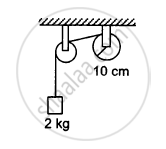
A string is wrapped on a wheel of moment of inertia 0⋅20 kg-m2 and radius 10 cm and goes through a light pulley to support a block of mass 2⋅0 kg as shown in the following figure. Find the acceleration of the block.
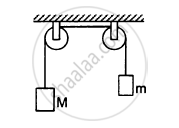
The pulleys shown in the following figure are identical, each having a radius R and moment of inertia I. Find the acceleration of the block M.
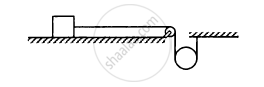
The descending pulley shown in the following figure has a radius 20 cm and moment of inertia 0⋅20 kg-m2. The fixed pulley is light and the horizontal plane frictionless. Find the acceleration of the block if its mass is 1⋅0 kg.
A wheel of moment of inertia 0⋅10 kg-m2 is rotating about a shaft at an angular speed of 160 rev/minute. A second wheel is set into rotation at 300 rev/minute and is coupled to the same shaft so that both the wheels finally rotate with a common angular speed of 200 rev/minute. Find the moment of inertia of the second wheel.
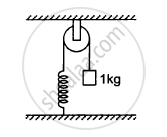
The pulley shown in the following figure has a radius of 20 cm and moment of inertia 0⋅2 kg-m2. The string going over it is attached at one end to a vertical spring of spring constant 50 N/m fixed from below, and supports a 1 kg mass at the other end. The system is released from rest with the spring at its natural length. Find the speed of the block when it has descended through 10 cm. Take g = 10 m/s2.
Four bodies of masses 2 kg, 3 kg, 4 kg and 5 kg are placed at points A, B, C, and D respectively of a square ABCD of side 1 metre. The radius of gyration of the system about an axis passing through A and perpendicular to plane is
From a circular ring of mass ‘M’ and radius ‘R’ an arc corresponding to a 90° sector is removed. The moment of inertia of the remaining part of the ring about an axis passing through the centre of the ring and perpendicular to the plane of the ring is ‘K’ times ‘MR2 ’. Then the value of ‘K’ is ______.
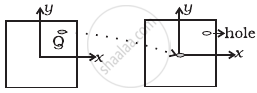
A uniform square plate has a small piece Q of an irregular shape removed and glued to the centre of the plate leaving a hole behind (Figure). The moment of inertia about the z-axis is then ______.
Moment of inertia (M.I.) of four bodies, having same mass and radius, are reported as :
I1 = M.I. of thin circular ring about its diameter,
I2 = M.I. of circular disc about an axis perpendicular to disc and going through the centre,
I3 = M.I. of solid cylinder about its axis and
I4 = M.I. of solid sphere about its diameter.
Then -
A cubical block of mass 6 kg and side 16.1 cm is placed on a frictionless horizontal surface. It is hit by a cue at the top to impart impulse in the horizontal direction. The minimum impulse imparted to topple the block must be greater than ______ kg m/s.
The moment of inertia of a thin rod about an axis passing through its mid point and perpendicular to the rod is 2400 g cm2. The length of the 400 g rod is nearly ______.
