Advertisements
Advertisements
प्रश्न
The pressure P1 at a certain depth in river water and P2 at the same depth in sea water are related as :
विकल्प
P1 > P2
P1= P2
P1 < P2
P1 - P2 = atmospheric pressure
Advertisements
उत्तर
The pressure P1 at a certain depth in river water and P2 at the same depth in sea water are related as : P1 < P2
संबंधित प्रश्न
What is upthrust ?
When a boat is partially immersed in water, it displaces 600 kg of water. How much is the buoyant force acting on the boat in newtons ? (g = 10 m s-2)
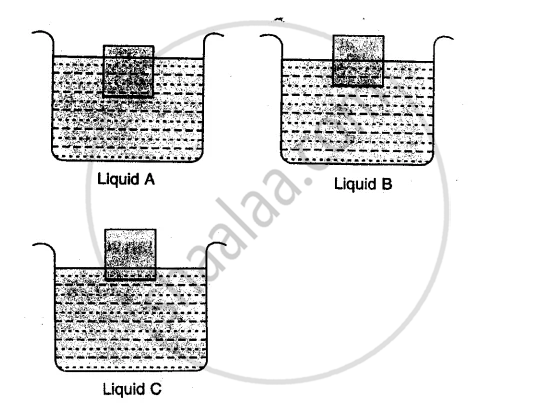
The diagram given below show a body floating in three different liquids. A, B and C at different levels.
(a) In which liquid does the body experience the greatest buoyant force?
(b) Which liquid has the least density?
(c) Which liquid has the highest density?
State whether pressure is a scalar or vector?
Why is the tip of an allpin made sharp?
What is meant by the term buoyancy?
What is the cause of upthrust? At which point can it be considered to act?
A body experiences an upthrust F1 in river water and F2 in sea water when dipped up to the same level. Which is more, F1 or F2? Give reason.
Calculate the hydrostatic pressure exerted by water at the bottom of a beaker. Take the depth of water as 40 cm, the density of water 1000 kgm−3 and g = 9.8 ms−2.
What is meant by up thrust?
