Advertisements
Advertisements
प्रश्न
The perpendicular distance of the P (4,3) from y-axis is
विकल्प
4
3
5
none of these
Advertisements
उत्तर
The point P(4,3) is shown in the graph given below:
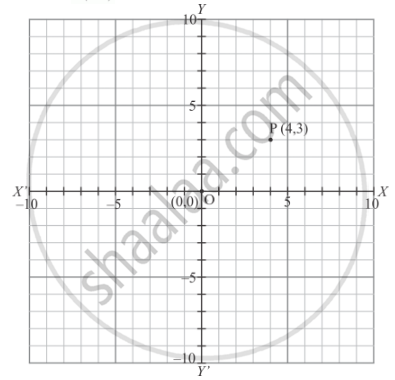
Thus the perpendicular distance of the point P(4,3) from y−axis is 4.
APPEARS IN
संबंधित प्रश्न
Find the value of x such that PQ = QR where the coordinates of P, Q and R are (6, -1), (1, 3) and (x, 8) respectively.
The points A(2, 0), B(9, 1) C(11, 6) and D(4, 4) are the vertices of a quadrilateral ABCD. Determine whether ABCD is a rhombus or not.
Find the coordinates of the points which divide the line segment joining the points (-4, 0) and (0, 6) in four equal parts.
Show that the following points are the vertices of a square:
A(0, –2), B(3, 1), C(0, 4) and D(–3, 1)
Find the value of a, so that the point (3, a) lies on the line represented by 2x – 3y = 5.
The perpendicular distance of the point P (4, 3) from x-axis is
The area of the triangle formed by the points A(2,0) B(6,0) and C(4,6) is
If (a,b) is the mid-point of the line segment joining the points A (10, - 6) , B (k,4) and a - 2b = 18 , find the value of k and the distance AB.
The coordinates of a point whose ordinate is `-1/2` and abscissa is 1 are `-1/2, 1`.
If the points P(1, 2), Q(0, 0) and R(x, y) are collinear, then find the relation between x and y.
Given points are P(1, 2), Q(0, 0) and R(x, y).
The given points are collinear, so the area of the triangle formed by them is `square`.
∴ `1/2 |x_1(y_2 - y_3) + x_2(y_3 - y_1) + x_3(y_1 - y_2)| = square`
`1/2 |1(square) + 0(square) + x(square)| = square`
`square + square + square` = 0
`square + square` = 0
`square = square`
Hence, the relation between x and y is `square`.
