हिंदी

The individual flattened stacks of membranous structures inside the chloroplasts are known as - Biology

Advertisements
Advertisements

प्रश्न

The individual flattened stacks of membranous structures inside the chloroplasts are known as :
A. Grana
B. Stroma
C. Thylakoids
D. Cristae

Advertisements

उत्तर

Thylakoids
(The individual flattened stacks of membrane material inside the chloroplast are known as thylakoids.)

shaalaa.com
  क्या इस प्रश्न या उत्तर में कोई त्रुटि है?
2015-2016 (March)

APPEARS IN

संबंधित प्रश्न

Identify the odd one in each set : Transpiration, Photosynthesis, Phagocytosis, Guttation


Name the following:

The cell organelle responsible for photosynthesis.


Choose the correct answer:
Which one of the following is the best reason for leaving a plant in a dark place before carrying out experiments on photosynthesis?


What is the importance of photosynthesis in the life of the following:

Non-green plants


How do non-green plants such as fungi and bacteria obtain their nourishment?


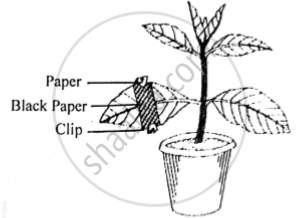
The figure given below is for performing an experiment on photosynthesis.

Answer the following:
(i) What is the aim of this experiment?
(ii) Describe an experiment to show that light is necessary for photosynthesis.
(iii) What do you conclude from this experiment?
(iv) What is the role of light in photosynthesis?


Give technical term:

Organisms which cannot prepare their own food by photosynthesis.


Column ‘II’ is a list of items related to ideas in Column ‘I’. Match the term in Column ‘II’ with the suitable idea given in Column ‘I’.

  Column I   Column II
(i) Grana (a) Decomposers
(ii) Autotrophs (b) Light reaction
(iii) By-products of photosynthesis (c) Animals
(iv) Photolysis (d) Oxygen
(v) Bacteria and fungi (e) Stimulated by light
(vi) Chloroplast (f) Power
(vii) Oxygen and water (g) Raw material
(viii) Sunlight (h) Machinery
(ix) CO2 and water (i) End products
(x) Glucose (sugar) (j) Workrooms
(xi) Cells in the leaf (k) By-products.


Draw the structure of the stomata and label the parts. 


An organism A which cannot move from one place to another makes a simple food B from the substances C and D available in the environment. This food is made in the presence of green-colored substance E present in organs F in the presence of light energy in a process called G. Some of the simple food B also gets converted into a complex food H for storage purposes. Does this food give a blue-black color with iodine solution?

a. What is 

  1. organism A 
  2. food B?
  3. food H?

b. What are C and D?

c. Name green-colored substance E and organ F.

d. What is the process G?


Share
Notifications

Englishहिंदीमराठी


      Forgot password?
Use app×