Advertisements
Advertisements
प्रश्न
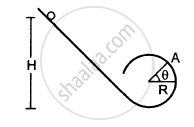
The following figure shows a small spherical ball of mass m rolling down the loop track. The ball is released on the linear portion at a vertical height H from the lowest point. The circular part shown has a radius R.
(a) Find the kinetic energy of the ball when it is at a point A where the radius makes an angle θ with the horizontal.
(b) Find the radial and the tangential accelerations of the centre when the ball is at A.
(c) Find the normal force and the frictional force acting on the if ball if H = 60 cm, R = 10 cm, θ = 0 and m = 70 g.
Advertisements
उत्तर
(a) Let the velocity and angular velocity of the ball at point A be v and ω, respectively.
Total kinetic energy at point A \[= \frac{1}{2}m v^2 + \frac{1}{2}I \omega^2\]
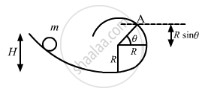
Total potential energy at point A \[= mg\left( R + R\sin\theta \right)\]
On applying the law of conservation of energy, we have
Total energy at initial point = Total energy at A
Therefore, we get
\[mgH = \frac{1}{2}m v^2 + \frac{1}{2}I \omega^2 + mgR\left( 1 + \sin\theta \right)\]
\[ \Rightarrow mgH - mgR\left( 1 + \sin\theta \right) = \frac{1}{2}m \nu^2 + \frac{1}{2}I \omega^2 \]
\[ \Rightarrow \frac{1}{2}m v^2 + \frac{1}{2}I \omega^2 = mg\left( H - R - R\sin\theta \right)........(1)\]
\[\text{Total }K . E . \text{ at } A = mg\left( H - R - R\sin\theta \right)\]
(b) Let us now find the acceleration components.
Putting \[I = \frac{2}{5}m R^2 \text{ and } \omega = \frac{v}{R}\] in equation (1), we get
\[\frac{7}{10}m v^2 = mg\left( H - R - R\sin\theta \right)\]
\[ \Rightarrow v^2 = \frac{10}{7}g\left( H - R - R\sin\theta \right).........(2)\]
Radial acceleration,
\[a_r = \frac{v^2}{R} = \frac{10}{7}\frac{g\left( H - R - R\sin\theta \right)}{R}\]
For tangential acceleration,
Differentiating equation (2) w.r.t. `'t'`,
\[2v\frac{dv}{dt} = - \left( \frac{10}{7} \right)gR\cos\theta\frac{d\theta}{dt}\]
\[ \Rightarrow \omega R\frac{dv}{dt} = - \left( \frac{5}{7} \right) gR\cos\theta\frac{d\theta}{dt}\]
\[ \Rightarrow \frac{dv}{dt} = - \left( \frac{5}{7} \right) gcos\theta\]
\[ \Rightarrow a_t = - \left( \frac{5}{7} \right) gcos\theta\]
(c) At \[\theta = 0,\] from the free body diagram, we have
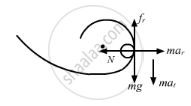
Normal force = \[N = m a_r\]
\[N = m \times \frac{10}{7}\frac{g\left( H - R - R\sin\theta \right)}{R}\]
\[= \left( \frac{70}{1000} \right) \times \left( \frac{10}{7} \right) \times 10 \left\{ \frac{0 . 6 - 0 . 1}{0 . 1} \right\}\]
\[= 5 N\]
At \[\theta = 0,\] from the free body diagram, we get
\[f_r = mg - m a_t..........\left(f_r=\text{ Force of friction}\right)\]
\[\Rightarrow f_r = m\left( g - a_t \right)\]
\[= m\left( 10 - \frac{5}{7} \times 10 \right)\]
\[ = 0 . 07\left( 10 - \frac{5}{7} \times 10 \right)\]
\[= \frac{1}{100} \left( 70 - 50 \right) = 0 . 2 N\]
APPEARS IN
संबंधित प्रश्न
Suppose we define a quantity 'Linear momentum' as linear momentum = mass × speed.
The linear momentum of a system of particles is the sum of linear momenta of the individual particles. Can we state principle of conservation of linear momentum as "linear momentum of a system remains constant if no external force acts on it"?
Use the definition of linear momentum from the previous question. Can we state the principle of conservation of linear momentum for a single particle?
Consider the situation of the previous problem. Take "the table plus the ball" as the system. friction between the table and the ball is then an internal force. As the ball slows down, the momentum of the system decreases. Which external force is responsible for this change in the momentum?
A van is standing on a frictionless portion of a horizontal road. To start the engine, the vehicle must be set in motion in the forward direction. How can be persons sitting inside the van do it without coming out and pushing from behind?
Consider the following two statements:
(A) Linear momentum of a system of particles is zero.
(B) Kinetic energy of a system of particles is zero.
Consider the following two statements:
(A) The linear momentum of a particle is independent of the frame of reference.
(B) The kinetic energy of a particle is independent of the frame of reference.
The quantities remaining constant in a collisions are
A shell is fired from a cannon with a velocity V at an angle θ with the horizontal direction. At the highest point in its path, it explodes into two pieces of equal masses. One of the pieces retraces its path to the cannon. The speed of the other piece immediately after the explosion is
In an elastic collision
(a) the kinetic energy remains constant
(b) the linear momentum remains constant
(c) the final kinetic energy is equal to the initial kinetic energy
(d) the final linear momentum is equal to the initial linear momentum.
A ball hits a floor and rebounds after an inelastic collision. In this case
(a) the momentum of the ball just after the collision is same as that just before the collision
(b) the mechanical energy of the ball remains the same during the collision
(c) the total momentum of the ball and the earth is conserved
(d) the total energy of the ball and the earth remains the same
A ball of mass 50 g moving at a speed of 2.0 m/s strikes a plane surface at an angle of incidence 45°. The ball is reflected by the plane at equal angle of reflection with the same speed. Calculate (a) the magnitude of the change in momentum of the ball (b) the change in the magnitude of the momentum of the ball.
Light in certain cases may be considered as a stream of particles called photons. Each photon has a linear momentum h/λ where h is the Planck's constant and λ is the wavelength of the light. A beam of light of wavelength λ is incident on a plane mirror at an angle of incidence θ. Calculate the change in the linear momentum of a photon as the beam is reflected by the mirror.
A gun is mounted on a railroad car. The mass of the car, the gun, the shells and the operator is 50 m where m is the mass of one shell. If the velocity of the shell with respect to the gun (in its state before firing) is 200 m/s, what is the recoil speed of the car after the second shot? Neglect friction.
A 60 kg man skating with a speed of 10 m/s collides with a 40 kg skater at rest and they cling to each other. Find the loss of kinetic energy during the collision.
A bullet of mass 20 g travelling horizontally with a speed of 500 m/s passes through a wooden block of mass 10.0 kg initially at rest on a level surface. The bullet emerges with a speed of 100 m/s and the block slides 20 cm on the surface before coming to rest. Find the friction coefficient between the block and the surface (See figure).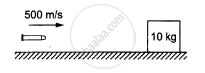
A bullet of mass 25 g is fired horizontally into a ballistic pendulum of mass 5.0 kg and gets embedded in it. If the centre of the pendulum rises by a distance of 10 cm, find the speed of the bullet.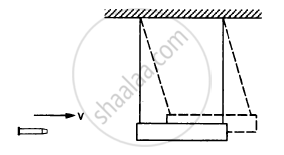
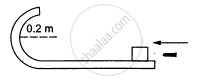
A bullet of mass 10 g moving horizontally at a speed of 50√7 m/s strikes a block of mass 490 g kept on a frictionless track as shown in figure. The bullet remains inside the block and the system proceeds towards the semicircular track of radius 0.2 m. Where will the block strike the horizontal part after leaving the semicircular track?
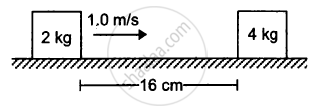
The friction coefficient between the horizontal surface and each of the block shown in figure is 0.20. The collision between the blocks is perfectly elastic. Find the separation between the two blocks when they come to rest. Take g = 10 m/s2.
A metre stick is held vertically with one end on a rough horizontal floor. It is gently allowed to fall on the floor. Assuming that the end at the floor does not slip, find the angular speed of the rod when it hits the floor.
A uniform rod pivoted at its upper end hangs vertically. It is displaced through an angle of 60° and then released. Find the magnitude of the force acting on a particle of mass dm at the tip of the rod when the rod makes an angle of 37° with the vertical.
