Advertisements
Advertisements
प्रश्न
The focal length of a convex lens is 25 cm. At what distance from the optical centre of the lens an object be placed to obtain a virtual image of twice the size?
Advertisements
उत्तर
Focal length, f = +25 cm
Image is virtual and magnified, m = +2
For a lens, magnification is
m = `v/u`
∴ + 2 = `v/u`
∴ v = 2u
Lens formula is,
`1/v = 1/u = 1/f`
∴ `1/(2u) - 1/u = 1/25`
∴ `-1/(2u) = 1/25`
∴ 2u = −25 cm
∴ u = `-25/2`
∴ u = −12.5 cm
APPEARS IN
संबंधित प्रश्न
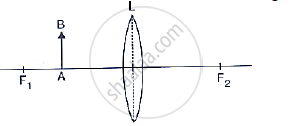
The following diagram shows an object AB and a converging lens L with foci F1 and F2. Draw two rays from the object AB and complete the diagram to locate the position of the image CD. Also mark on the diagram the position of eye from where the image can be viewed.
Where is the object placed with respect to the principal focus of a magnifying glass, so as to see its enlarged image? Where is the image obtained?
What information we seek by the linear magnification of the image when it is positive or negative?
Name the lens for which magnification can be 1. For what position of the object will the magnification be 1?
How is the magnification (m) produced by a lens related to the object distance (u) and the image distance (v)?
An object is placed in front of a lens between its optical centre and the focus and forms a virtual, erect, and diminished image. Draw a ray diagram to show the formation of the image with the above-stated characteristics.
Show with the help of a ray diagram, the path of the ray when incident normally on the first surface of the glass block, through the block and the liquid.
What is a magnifying glass (or a simple microscope)? Draw a ray diagram to show how a convex lens may be used as a magnifying glass. Where should the object be placed? State three characteristics of the image formed.
Write an expression for the magnifying power of a simple microscope. How can it be increased?
State two uses of magnifying glass.
