Advertisements
Advertisements
प्रश्न
The figure blow shows a variable resistor in a dimmer switch.
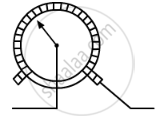
How would you turn the switch to make the lights: (a) brighter, and (b) dimmer? Explain your answer.
Advertisements
उत्तर
The switch is turned to the right for brighter light and is turned to the left for dimmer light. This happens because when the switch is turned to the right, it offers less resistance and when turned to the left, it offers more resistance.
APPEARS IN
संबंधित प्रश्न
Use the data in the Table given below to answer the following –
Which among iron and mercury is a better conductor?
Table give below Electrical resistivity of some substances at 20°C
| Electrical resistivity of some substances at 20°C | ||
| − | Material | Resistivity (Ω m) |
| Conductors |
Silver | 1.60 × 10⁻⁸ |
| Copper | 1.62 × 10⁻⁸ | |
| Aluminium | 2.63 × 10⁻⁸ | |
| Tungsten | 5.20 × 10⁻⁸ | |
| Nickel | 6.84 × 10⁻⁸ | |
| Iron | 10.0 × 10⁻⁸ | |
| Chromium | 12.9 × 10⁻⁸ | |
| Mercury | 94.0 × 10⁻⁸ | |
| Manganese | 1.84 × 10⁻⁶ | |
| Alloys |
Constantan (alloy of Cu and Ni) |
49 × 10−6 |
| Manganin (alloy of Cu, Mn and Ni) |
44 × 10−6 | |
| Nichrome (alloy of Ni, Cr, Mn and Fe) |
100 × 10−6 | |
| Insulators | Glass | 1010 − 1014 |
| Hard rubber | 1013 − 1016 | |
| Ebonite | 1015 − 1017 | |
| Diamond | 1012 − 1013 | |
| Paper (dry) | 1012 | |
What is (a) the highest, (b) the lowest total resistance that can be secured by combinations of four coils of resistance 4 Ω, 8 Ω, 12 Ω, 24 Ω?
A copper wire has diameter 0.5 mm and resistivity of 1.6 × 10⁻⁸Ω m. What will be the length of this wire to make its resistance 10 Ω? How much does the resistance change if the diameter is doubled?
Why are alloys commonly used in electrical heating devices? Give reason.
Which of the following are conductors and which are insulators?
Sulphur, Silver, Copper, Cotton, Aluminium, Air, Nichrome, Graphite, Paper, porcelain, Mercury, Mica, Bakelite, Polythene, Manganin.
Distinguish between good conductors, resistors and insulators. Name two good conductors, two resistance and two insulators.
Classify the following into good conductors, resistors and insulators:
Rubber, Mercury, Nichrome, Polythene, Aluminium, Wood, Manganin, Bakelite, Iron, Paper, Thermocol, Metal coin
What is meant by the "resistance of a conductor" ? Write the relation between resistance, potential difference and current.
Which among iron and mercury is a better conductor of electricity?
Which has more resistance:
a long piece of nichrome wire or a short one?
Which has more resistance:
a thick piece of nichrome wire or a thin piece?
What do you understand by the "resistivity" of a substance?
A wire is 1.0 m long, 0.2 mm in diameter and has a resistance of 10 Ω. Calculate the resistivity of its material?
Calculate the area of cross-section of a wire if its length is 1.0 m, its resistance is 23 Ω and the resistivity of the material of the wire is 1.84 × 10⁻⁶ Ω m.
Write the relation between resistance and electrical resistivity of the material of a conductor in the shape of a cylinder of length `'l'` and area of cross-section `'A'` . Hence derive the S.I. unit of electrical resistivity.
The element used almost exclusively for filaments of incandescent lamps:
The effective resistance between A and B is:

The resistance of a wire of 0.01 cm radius is 10 Ω. If the resistivity of the wire is 50 × 10-8 Ω, find the length of this wire.
How will the resistance of a wire be affected if its
- length is doubled, and
- radius is also doubled ?
Give justification for your answer.
