Advertisements
Advertisements
प्रश्न
The figure blow shows a variable resistor in a dimmer switch.
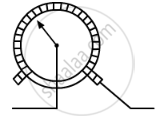
How would you turn the switch to make the lights: (a) brighter, and (b) dimmer? Explain your answer.
Advertisements
उत्तर
The switch is turned to the right for brighter light and is turned to the left for dimmer light. This happens because when the switch is turned to the right, it offers less resistance and when turned to the left, it offers more resistance.
APPEARS IN
संबंधित प्रश्न
On what factors does the resistance of a conductor depend?
Use the data in the Table given below to answer the following –
Which among iron and mercury is a better conductor?
Table give below Electrical resistivity of some substances at 20°C
| Electrical resistivity of some substances at 20°C | ||
| − | Material | Resistivity (Ω m) |
| Conductors |
Silver | 1.60 × 10⁻⁸ |
| Copper | 1.62 × 10⁻⁸ | |
| Aluminium | 2.63 × 10⁻⁸ | |
| Tungsten | 5.20 × 10⁻⁸ | |
| Nickel | 6.84 × 10⁻⁸ | |
| Iron | 10.0 × 10⁻⁸ | |
| Chromium | 12.9 × 10⁻⁸ | |
| Mercury | 94.0 × 10⁻⁸ | |
| Manganese | 1.84 × 10⁻⁶ | |
| Alloys |
Constantan (alloy of Cu and Ni) |
49 × 10−6 |
| Manganin (alloy of Cu, Mn and Ni) |
44 × 10−6 | |
| Nichrome (alloy of Ni, Cr, Mn and Fe) |
100 × 10−6 | |
| Insulators | Glass | 1010 − 1014 |
| Hard rubber | 1013 − 1016 | |
| Ebonite | 1015 − 1017 | |
| Diamond | 1012 − 1013 | |
| Paper (dry) | 1012 | |
What is (a) the highest, (b) the lowest total resistance that can be secured by combinations of four coils of resistance 4 Ω, 8 Ω, 12 Ω, 24 Ω?
Why are copper and aluminium wires usually employed for electricity transmission?
Fill in the following blanks with suitable words:
Copper is a good .......... Plastic is an ..........
Which has less electrical resistance : a thin wire or a thick wire (of the same length and same material)?
Classify the following into good conductors, resistors and insulators:
Rubber, Mercury, Nichrome, Polythene, Aluminium, Wood, Manganin, Bakelite, Iron, Paper, Thermocol, Metal coin
What happens to the resistance as the conductor is made thinner?
What happens to the resistance as the conductor is made thicker?
Which among iron and mercury is a better conductor of electricity?
What will be the resistance of a metal wire of length 2 metres and area of cross-section 1.55 × 10⁻⁶ m2 if the resistivity of the metal be 2.8 × 10⁻⁸ Ω m?
Give two examples of substances which are good conductors of electricity. Why do you think they are good conductors of electricity?
Calculate the resistance of a copper wire 1.0 km long and 0.50 mm diameter if the resistivity of copper is 1.7 × 10⁻⁸ Ω m.
How does the resistance of a conductor depend on:
area of cross-section of the conductor?
What would be the effect on the resistance of a metal wire of:
increasing its temperature?
How does the resistance of a wire change when:
its material is changed to one whose resistivity is three times?
The effective resistance between A and B is:

How will you infer with the help of an experiment that the same current flows through every part of the circuit containing three resistances in series connected to a battery?
The resistance of a wire of 0.01 cm radius is 10 Ω. If the resistivity of the wire is 50 × 10-8 Ω, find the length of this wire.
