Advertisements
Advertisements
प्रश्न
The extracellular fluid which always flows from body tissues to the heart is called ______.
Advertisements
उत्तर
The extracellular fluid which always flows from body tissues to the heart is called lymph.
Explanation:
Lymph is a clear fluid that is filtered out of blood capillaries into the spaces between body tissues (interstitial spaces). Unlike blood, which circulates in a continuous closed loop, the lymphatic system is a one-way transport network.
APPEARS IN
संबंधित प्रश्न
Name the type of T-lymphocyte which secretes perforins.
Which of the following are 'scavenger cells'?
(a) Lymphocytes
(b) Erythrocytes
(c) Basophils
(d) Macrophages
What is lymph?
Name a circulatory fluid in the human body other than blood.
| A liquid X of colour Y circulates in the human body only in one direction : from body tissues to the heart. Among other things, liquid X contains germs from cells and dead cells. The liquid X is cleaned of germs and dead cells by a special type of white blood cells called Z. This cleaned liquid is then put into the blood circulatory system in subclavian veins. |
- What is (i) liquid X, and (ii) colour Y?
- What is Z?
- The liquid X is somewhat similar to a component of blood. Name this component.
- Why is liquid X not red?
The diagram below shows part of the capillary bed in an organ of the human body. Some of the blood arriving at the capillaries at points labeled A, moves out into the spaces between the tissue cells. Study the diagram and answer the questions that follow:

Some of the liquid surrounding the cells does not pass directly back into the blood but eventually reaches it by another route through vessel X. name the fluid present in vessel X.
The diagram below shows part of the capillary bed in an organ of the human body. Some of the blood arriving at the capillaries at points labeled A, moves out into the spaces between the tissue cells. Study the diagram and answer the questions that follow:
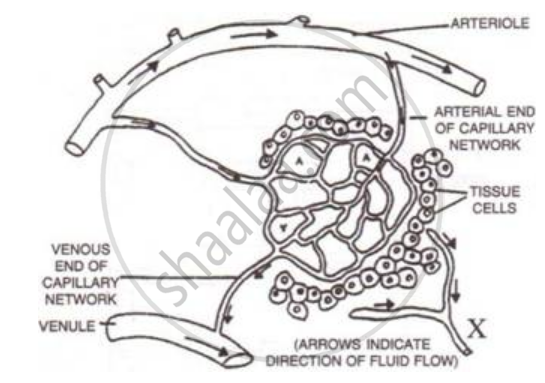
State two important functions performed in our body by the fluid present in vessel X.
State the Function: Lymph
Multiple Choice Questions
The chief function of lymph nodes in mammals is to:
Distinguish between Blood capillary and lymph capillary
Lymph is ______ with almost similar composition to the blood except RBCs, platelets and some proteins.
For which of the following reason it is much easier for a small animal to run uphill than for a large animal?
Lymph can be defined as ______.
Match the terms given under Column ‘A’ with their functions given under Column ‘B’ and select the answer from the options given below:
| Column I | Column II |
| A. Lymphatic System | i. Carries oxygenated blood |
| B. Pulmonary vein | ii. Immune Response |
| C. Thrombocytes | iii. To drain back the tissue fluid to the circulatory system |
| D. Lymphocytes | iv. Coagulation of blood |
How is lymph an important fluid involved in transportation? If lymphatic vessels get blocked, how would it affect the human body? Elaborate.
What is the other name of 'tissue fluid'? Write its two functions.
Choose the odd one out from the following terms and name the category to which the others belong:
Name the following:
Part of lymphatic system concerned with absorption of fats from the intestine.
Name the following:
A special lymphatic node on the sides of the neck.
