Advertisements
Advertisements
प्रश्न
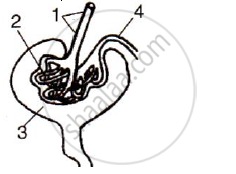
The diagram given below is that of a structure present in a human kidney.
Study the same and answer the questions that follow:

1) Name the structure represented in the diagram
2) What is the liquid entering part ‘1’ called?
Name two substances present in this liquid that are reabsorbed in the tubule.
3) What is the fluid that comes to part ‘2’ called?
Name the main nitrogenous waste in it.
4) Mention the three main steps involved in the formation of the fluid mentioned in (iii) above
5) Name the substance which may be present in the fluid in part ‘2’ if a person suffers from Diabetes mellitus.
Advertisements
उत्तर
1) Nephron
2)
- Glomerular filterate
- Glucose and Amino acids
3)
- Urine
- Urea
4) The 3 steps are
- Ultrafiltration
- Selective Reabsorption
- Tubular secretion
5) Glucose
APPEARS IN
संबंधित प्रश्न
Define excretion.
The organs which extract the nitrogenous wastes from the blood are ______.
Name the various organs of the human excretory system.
Tick the most appropriate answer.
The process of removing waste from the body is called
Study the diagram given alongside and then answer the question that follow:
Name the region in the kidney where the above structure is present?
The following diagram represents a mammalian kidney tubule (nephron) and its blood supply.

Parts indicated by the guidelines 1 to 8 are as follows:
1. Afferent arteriole from renal artery
2. efferent arteriole
3. Bowman’s capsule
4. Glomerulus;
5. Proximal convoluted tubule with blood capillaries;
6. Distal convoluted tubule with blood capillaries;
7. collecting tubule;
8. U-shaped loop of Henle
Study the diagram and answer the question that follow:
Where does ultrafiltration take place?
Give Technical Term:
The organ which filters out urea and uric acid from the bloodstream.
Choose the correct option.
Deproteinised plasma is not found in ______.
Osmoregulation maintains the osmolarity of blood at about ______.
Two green plants are kept separately in oxygen-free containers, one in the dark and the other in continuous light. Which one will live longer? Give reasons.
