Advertisements
Advertisements
प्रश्न
The cylindrical tube of a spray pump has a cross-section of 8.0 cm2 one end of which has 40 fine holes each of diameter 1.0 mm. If the liquid flow inside the tube is 1.5 m min–1, what is the speed of ejection of the liquid through the holes?
Advertisements
उत्तर १
Total cross-sectional area of 40 holes, `a_2`
`= 40 xx 22/7 xx (1xx10^(-3))^2/4 m^2`
`= 22/7 xx 10^(-5) m^2`
Cross-sectional area of tube, `a_1 = 8 xx 10^(-4) m^2`
Speed inside the tube,. `v_1 = 1.5 m min^(-1) = 1.5/60 ms^(-1)`
Speed of ejection, `v_2 = ?`
Using `a_2v_2 = a_1v_1`
We get
` v_2 = (a_1v_1)/a_2 = (8xx10^(-4) xx (1.5/60) xx 7)/(22xx10^(-5)) ms^(-1) = 0.64 ms^(-1)`
उत्तर २
Area of cross-section of the spray pump, A1 = 8 cm2 = 8 × 10⁻⁴ m2
Number of holes, n = 40`
Diameter of each hole, d = 1 mm = 1 × 10⁻³ m
Radius of each hole, r = d/2 = 0.5 × 10⁻³ m
Area of cross-section of each hole, a = πr2 = π (0.5 × 10⁻³)2 m2
Total area of 40 holes, A2 = n × a
= 40 × π (0.5 × 10⁻³)2 m2
= 31.41 × 10⁻⁶ m2
Speed of flow of liquid inside the tube, V1 = 1.5 m/min = 0.025 m/s
Speed of ejection of liquid through the holes = V2
According to the law of continuity, we have:
`A_1V_1 = A_2V_2`
`V_2 = (A_1V_1)/A_2`
`= (8xx10^(-4)xx0.025)/(31.61xx10^(-6))`
`= 0.633 m/s`
Therefore, the speed of ejection of the liquid through the holes is 0.633 m/s
APPEARS IN
संबंधित प्रश्न
Explain why To keep a piece of paper horizontal, you should blow over, not under, it
Explain why A spinning cricket ball in air does not follow a parabolic trajectory
In a test experiment on a model aeroplane in a wind tunnel, the flow speeds on the upper and lower surfaces of the wing are 70 m s–1and 63 m s–1 respectively. What is the lift on the wing if its area is 2.5 m2? Take the density of air to be 1.3 kg m–3.
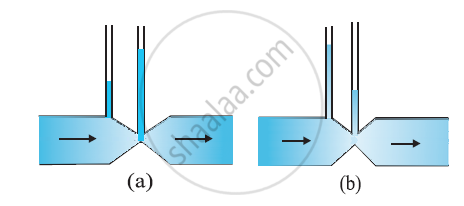
Figures (a) and (b) refer to the steady flow of a (non-viscous) liquid. Which of the two figures is incorrect? Why?
A Gipsy car has a canvass top. When the car runs at high speed, the top bulges out. Explain.
Bernoulli's theorem is based on the conservation of
Water is flowing through a long horizontal tube. Let PA and PB be the pressures at two points A and B of the tube.
Suppose the tube in the previous problem is kept vertical with A upward but the other conditions remain the same. the separation between the cross sections at A and B is 15/16 cm. Repeat parts (a), (b) and (c) of the previous problem. Take g = 10 m/s2.
Suppose the tube in the previous problem is kept vertical with B upward. Water enters through B at the rate of 1 cm3/s. Repeat parts (a), (b) and (c). Note that the speed decreases as the water falls down.
Which of the following is NOT an example of the application of Bernoulli's principle?
Dynamic lift caused by spinning is called ______.
The working of venturimeter is based on ______.
In the widest part of the horizontal pipe, oil is flowing at a rate of 2 m/sec. The speed (in m/s) of the flow of oil in the narrow part of the tube if the pressure difference in the broad and narrow parts of the pipe is 0.25 ρoilg, is ______ m/s.
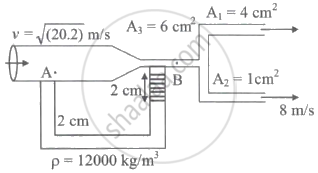
Calculate the velocity with which the liquid gushes out of the 4 cm2 outlet, if the liquid flowing in the tube is water and the liquid in the U tube has a specificity 12. The velocity of the liquid at point A is `sqrt20.2` m/s ______.
Two wires are made of the same material and have the same volume. However wire 1 has cross-sectional area A and wire 2 has cross-sectional area 9A. If the length of wire 1 increases by Δx on applying force F, how much force is needed to stretch wire 2 by the same amount?
A tank is filled with water of density 1 g cm-3 and oil of density 0.9 g cm3. The height of water layer is 100 cm and of the oil layer is 400 cm. If g = 980 cms-2, then the velocity of efflux from an opening in the bottom of the tank is ______.
Explain the working of an atomizer.
