Advertisements
Advertisements
प्रश्न
Take two similar transparent glass bottles having wide mouths. Put a few crystals of potassium permanganate or pour a few drops of ink in one bottle. Fill this bottle with hot water. Fill the other bottle with cold water. Cover the cold water bottle with a thick piece of paper such as a postcard. Press the postcard firmly with one hand and hold the bottle with the other hand. Invert the bottle and place it on top of the hot water bottle. Hold both the bottles firmly. Ask some other person to pull the postcard. Observe what happens. Explain.
Advertisements
उत्तर
Observation and Explanation:
-
Setup:
- Take two similar transparent glass bottles with wide mouths.
- Put a few crystals of potassium permanganate or a few drops of ink in one bottle and fill it with hot water.
- Fill the other bottle with cold water.
- Cover the cold water bottle with a thick piece of paper (such as a postcard).
- Press the postcard firmly with one hand and hold the bottle with the other hand.
- Invert the cold water bottle and place it on top of the hot water bottle.
- Hold both bottles firmly and ask someone to pull the postcard.
-
Observation:
- When the postcard is pulled out, the coloured hot water from the bottom bottle rises and mixes with the cold water in the top bottle, creating a convection current.
-
Explanation:
- Hot water is less dense than cold water. When the postcard is removed, the hot water from the bottom bottle rises into the cold water bottle, and the cold water descends. This movement is due to the difference in density and results in the formation of a convection current, visibly mixing the colors in the water.
APPEARS IN
संबंधित प्रश्न
Give two examples each of conductors and insulators of heat.
Look at Figure. Mark where the heat is being transferred by conduction, by convection and by radiation.
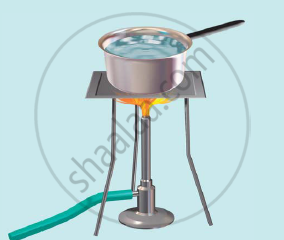
Write true or false for a given statement.
Medium is necessary for the transfer of heat by radiation.
Write true or false for a given statement.
Black surfaces are the poor absorbers of heat radiations.
Fill in the blank
Heat transfer in liquids and gases is by ________.
Select the correct alternative
In the process of convection, heat travel
______ of heat does not require a medium.
The earth receives heat from the sun by ______.
Match the items in column-I to the items in column-II
| Column-I | Column-II | ||
| 1. | Linear expansion | (a) | change in volume |
| 2. | Superficial expansion | (b) | hot body to cold body |
| 3. | Cubical expansion | (c) | 1.381 X 10⁻²³ JK-1 |
| 4. | Cubical expansion | (d) | change in length |
| 5. | Boltzmann constant | (e) | change in area |
Wrap a thin paper strip tightly around an iron rod. Try to burn the paper with candle while rotating the iron rod continuously. Does it burn? Explain your observation.
