Advertisements
Advertisements
प्रश्न
Explain which mode of heat transfer causes sea breezes and land breezes.
Advertisements
उत्तर
Sea breezes and land breezes are caused by the mode of heat transfer called convection.
-
Sea Breeze (Daytime):
- During the day, the land heats up faster than the sea due to the difference in heat capacity.
- The warm air over the land rises, creating a low-pressure area.
- Cooler, denser air from the sea moves in to replace it, creating a sea breeze from the sea to the land.
-
Land Breeze (Nighttime):
- At night, the land cools down faster than the sea.
- The warm air over the sea rises, creating a low-pressure area.
- Cooler air from the land moves toward the sea, forming a land breeze from the land to the sea.
APPEARS IN
संबंधित प्रश्न
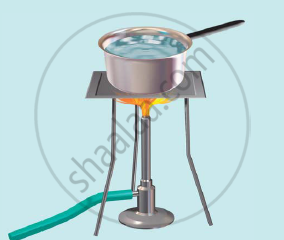
Look at Figure. Mark where the heat is being transferred by conduction, by convection and by radiation.
Write true or false for a given statement.
On touching a lump of ice, we feel cold because some heat passes from our body to the ice.
Write true or false for a given statement.
Liquids are heated by conduction and radiation.
Give one example of heat transfer by radiation.
The earth receives heat from the sun by ______.
Why are the houses in Rajasthan painted white?
Why are heaters fitted near the floor and air conditioners near the ceiling of a room?
Heat is the transfer of energy between two objects at different temperatures.
Wrap a thin paper strip tightly around an iron rod. Try to burn the paper with candle while rotating the iron rod continuously. Does it burn? Explain your observation.
Take two similar transparent glass bottles having wide mouths. Put a few crystals of potassium permanganate or pour a few drops of ink in one bottle. Fill this bottle with hot water. Fill the other bottle with cold water. Cover the cold water bottle with a thick piece of paper such as a postcard. Press the postcard firmly with one hand and hold the bottle with the other hand. Invert the bottle and place it on top of the hot water bottle. Hold both the bottles firmly. Ask some other person to pull the postcard. Observe what happens. Explain.
