Advertisements
Advertisements
प्रश्न
State three differences between the three classes of levers.
अंतर स्पष्ट करें
Advertisements
उत्तर
| Class I | Class II | Class III | |
| 1. | It has the fulcrum between the load and effort. | It has the load between the fulcrum and effort. | It has an effort between the fulcrum and the load. |
| 2. | The effort arm can be shorter, equal to or longer than the load arm. | The effort arm is bigger than the load arm. | The effort arm is always shorter than the load arm. |
| 3. | The mechanical advantage can be less than, equal to, or greater than 1. | The mechanical advantages are always greater than 1. | The mechanical advantages are always less than 1. |
| 4. | The load and effort are in the same direction. | The load and effort are in opposite directions. | The load and effort are in opposite directions. |
shaalaa.com
क्या इस प्रश्न या उत्तर में कोई त्रुटि है?
APPEARS IN
संबंधित प्रश्न
What is a lever?
Name the class to which the following lever belong:
A pair of scissors
Name the class to which the following lever belong:
a lemon squeezer
The diagram given below shows the three kinds of levers. Name the class of lever and give one example of the class.
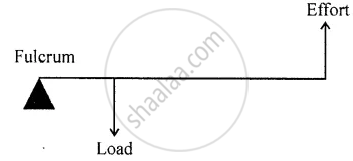
Draw diagram to illustrate the position of fulcrum, load, and effort, of the following:
a see-saw.
Classify the following into levers:
A door
Classify the following into levers:
Wheel barrow
Shows a lemon crusher. Name the class of lever.
Lemon juicer belongs to which type of lever? Why?
Match the following:
| 1. | Class I lever | a. | Wheelbarrow |
| 2. | Class II lever | b. | Seesaw |
| 3. | Class III lever | c. | Axe |
| 4. | Wedge | d. | Hockey sick |
