Advertisements
Advertisements
प्रश्न
State the two properties of the magnetic lines of force around a circular coil.
Advertisements
उत्तर
The important properties are:
(i) The magnetic lines of force near the wire are nearly circular, especially at the points where
the current enters or leaves the coil.
(ii) At the centre of the coil, the lines of force are almost parallel to each other, showing that the magnetic field at the centre or the coil may be considered uniform.
संबंधित प्रश्न
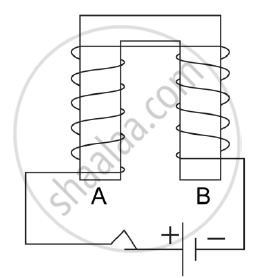
The diagram shows a coil wound around a U-shaped soft iron bar AB.
- What is the polarity induced at the ends A and B when the switch is pressed?
- Suggest one way to strengthen the magnetic field in the electromagnet.
- What will be the polarities at A and B if the direction of current is reversed in the circuit?
You are given an iron nail, a torch cell, and a long piece of insulated copper wire. With the help of a labelled neat diagram, describe in steps how you will make the nail, an electromagnet.
State two differences between an electromagnet and a permanent magnet.
Name the material of core in (a) an electric bell, (b) electromagnet, (c) a d.c. motor, (d) an a.c. generator and (e) a transformer.
A straight wire is held vertical and current is passed in it in the upward direction. A compass needle is kept near the wire in north of it. How is the needle deflected? What is the change in the deflection of the needle if the current in wire is reversed?
Describe a simple Experiment to demonstrate that there Exists a magnetic field around a current-carrying conductor.
Why is soft iron generally used as the core of the electromagnet?
State important properties (or characteristics) of magnetic lines of force around a straight conductor.
State the function of a split ring in D.C. motor.
Which magnet will you use?
Iron is to be separated from trash.
