हिंदी

State Huygen’S Principle. Using this Principle Explain How a Diffraction Pattern is Obtained on a Screen Due to a Narrow Slit on Which a Narrow Beam Coming from a ⇒ N = V λ V λ ω Monochromatic - Physics

Advertisements
Advertisements

प्रश्न

 State Huygen’s principle. Using this principle explain how a diffraction pattern is obtained on a screen due to a narrow slit on which a narrow beam coming from a `=> n = (vlamda)/(vlamda_omega)`monochromatic source of light is incident normally.

Advertisements

उत्तर

Huygen’s Principle

It states that

(i) Rays (light rays) are perpendicular to wave fronts.

Where wave fronts are defined as a surface of constant phase.

(ii) The time taken for light to travel from one wave front to another is same along any ray.

Diffraction Pattern:

Explanation of diffraction phenomena along with the following diagrams.
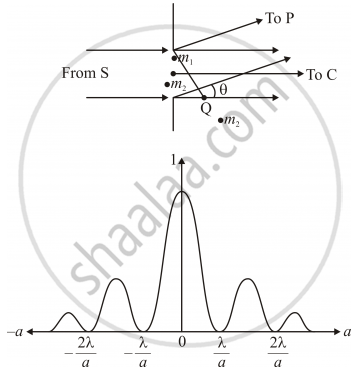
shaalaa.com
Refraction of Monochromatic Light
  क्या इस प्रश्न या उत्तर में कोई त्रुटि है?
2010-2011 (March) All India Set 3

संबंधित प्रश्न

When light travels from a rarer to a denser medium, the speed decreases. Does this decrease in speed imply a reduction in the energy carried by the wave?


In the wave picture of light, the intensity of light is determined by the square of the amplitude of the wave. What determines the intensity in the photon picture of light?


What kind of fringes do you expect to observe if white light is used instead of monochromatic light?


When monochromatic light travels from a rarer to a denser medium, explain the following, giving reasons:

(i) Is the frequency of reflected and refracted light same as the frequency of incident light?

(ii) Does the decrease in speed imply a reduction in the energy carried by light wave?


Which of the following sources provides the best monochromatic light?


The following figure shows three equidistant slits being illuminated by a monochromatic parallel beam of light. Let \[B P_0  - A P_0  = \lambda/3\text{ and }D >  > \lambda.\] (a) Show that in this case \[d = \sqrt{2\lambda D/3}.\] (b) Show that the intensity at P0 is three times the intensity due to any of the three slits individually.


Consider the situation shown in the figure. The two slits S1 and S2 placed symmetrically around the central line are illuminated by a monochromatic light of wavelength λ. The separation between the slits is d. The light transmitted by the slits falls on a screen ∑1placed at a distance D from the slits. The slit S3 is at the central line and the slit S4 is at a distance z from S3. Another screen ∑2 is placed a further distance D away from ∑1.Find the ratio of the maximum to minimum intensity observed on ∑2 if z is equal to


(a) \[z = \frac{\lambda D}{2d}\]

(b) \[\frac{\lambda D}{d}\]

(c) \[\frac{\lambda D}{4d}\]


Can the interference pattern be produced by two independent monochromatic sources of light? Explain.


Using the monochromatic light of the wavelength in the experimental set-up of the diffraction pattern as well as in the interference pattern where the slit separation is 1 mm, 10 interference fringes are found to be within the central maximum of the diffraction pattern. Determine the width of the single slit, if the screen is kept at the same distance from the slit in the two cases.


A ray of monochromatic light propagating in the air is incident on the surface of the water. Which of the following will be the same for the reflected and refracted rays?


Share
Notifications

Englishहिंदीमराठी


      Forgot password?
Use app×