Advertisements
Advertisements
प्रश्न
State and explain the law of demand.
Advertisements
उत्तर
The law of demand was introduced by Prof. Alfred Marshall in his book, ‘Principles of Economics’, which was published in 1890. The law explains the functional relationship between price and quantity demanded.
According to Prof. Alfred Marshall, “Other things being equal, the higher the price of a commodity, the smaller is the quantity demanded, and the lower the price of a commodity, the larger is the quantity demanded.” In other words, other factors remaining constant, if the price of a commodity rises, demand for it falls; and when the price of a commodity falls, demand for it rises. Thus, there is an inverse relationship between price and quantity demanded. Symbolically, the functional relationship between demand and price is expressed as:
Dx = f (Px)
Where D = Demand for a commodity
x = Commodity
f = Function
Px = Price of a commodity
| Price of a commodity ‘x’ (₹) |
Quantity demanded of the commodity ‘x’ (in kgs.) |
| 50 | 1 |
| 40 | 2 |
| 30 | 3 |
| 20 | 4 |
| 10 | 5 |
As shown in the table, when the price of commodity ‘x’ is ₹ 50, the quantity demanded is 1 kg. When the price falls from ₹ 50 to ₹ 40, the quantity demanded rises from 1 kg to 2 kg. Similarly, at a price of ₹ 30, the quantity demanded is 3 kgs, and when the price falls from ₹ 20 to ₹ 10, the quantity demanded rises from 4 kgs to 5 kgs. Thus, as the price of a commodity falls, quantity demanded rises, and when the price of the commodity rises, quantity demanded falls. This shows an inverse relationship between price and quantity demanded.
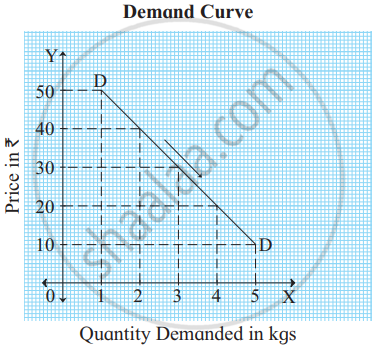
The X-axis represents the demand for the commodity, and the Y-axis represents the price of the commodity x. DD is the demand curve, which slopes downward from left to right because price and quantity demanded are inversely related.
APPEARS IN
संबंधित प्रश्न
Demand for necessaries is................
(elastic / inelastic / infinitely elastic / unitary elastic)
Demand curve and Supply curve.
Define demand. Name the factors affecting market demand.
When does ‘decrease’ in demand take place?
Compare inelastic demand with perfectly inelastic demand.
The demand of a commodity, when measured through the expenditure approach, is inelastic. A fall in its price will result in : (choose the correct alternative)
(a) No change in expenditure on it.
(b) Increase in expenditure on it.
(c) Decrease in expenditure on it.
(d) Anyone of the above.
Explain the problem of what to produce.
Any statement above demand for a good is considered complete only when the following is/are mentioned in it. ( choose the correct alternative)
a) Price of the good
b) Quantity of good
c) Period of time
d) All of the above
Demand for a good is termed inelastic through the expenditure approach when if (choose the correct alternative)
a) Price of good falls, expenditure on it rises
b) Price of the good falls, expenditure in it falls
c) Price of the good falls, expenditure on it remains unchanged
d) Price of the good rises, expenditure in it falls
Demand deposits include (choose the correct alternative)
(a) Saving account deposits and fixed deposits
(b) Saving account deposits and current account deposits
(c) Current account deposits and fixed deposits
(d) All types of deposits
If due to fall in the price of good X, demand for good Y rises, the two goods are : (Choose the correct alternative)
a. Substitutes
b. Complements
c. Not related
d. Competitive
When is demand called perfectly inelastic?
Demand for electricity is elastic.
Give reason or Explain the following statement :
Demand for habitually used goods is inelastic.
State whether the following statement is True or False :
Demand for necessary goods is inelastic.
Fill in the blank with proper alternatives given in the bracket:
Indirect demand is also known as _______ demand.
State whether the following statement is true or false.
Perfectly inelastic demand curve is parallel to ‘X’ axis.
Write short answer for the following question.
Explain the Law of Demand.
Fill in the blank using proper alternatives given in the bracket:
Demand for salt is ...............
Write whether the following statement is True or False:
Demand curve has a positive slope.
Write whether the following statement is True or False:
Demand for commodities depends upon various factors.
Write whether the following statement is True or False:
Salt has elastic demand.
Define the concept of demand schedule.
Distinguish between :
Individual demand schedule and Market demand schedule.
fill in the blank with appropriate alternatives given in the bracket:
Demand for salt is ___________.
Write the answer in ‘one’ or ‘two’ paras.
What are the main determinants of aggregate demand?
Explain the following concepts or give definitions.
Demand
Fill in the blank with appropriate alternatives given below
When price of commodity rises, the demand for it ______________.
Fill in the blank with appropriate alternatives given below:
When less is purchased at the constant price, it is called _______ in demand.
Fill in the blank with appropriate alternatives given below:
Market demand is an aggregate of purchasing by _________ buyers.
Fill in the blank with appropriate alternatives given below:
Indirect demand is also known as _____________ demand.
Match the following:
|
Group A
|
Group B
|
|
1. Demand and price
|
a. Substitute goods
|
|
2. Tea and coffee
|
b. Inverse relation
|
|
3. Inferior goods
|
c. Joint demand
|
|
4. Factors of production
|
d. Distribution of income
|
|
5. Pen and ink
|
e. Composite demand
|
|
|
f. Giffen goods
|
|
|
g. Indirect demand
|
State whether the following statement is TRUE and FALSE
Demand curve slopes upward from left to right.
State whether the following statement is TRUE and FALSE
Desire means demand.
State whether the following statement is TRUE and FALSE
Quantity demanded varies directly with price.
State whether the following statement is TRUE and FALSE
Law of demand is explained by Prof. Robbins.
State whether the following statement is TRUE and FALSE
Individual demand is a demand by single buyer.
Define the following concept:
Derived demand
Define or explain the following concept:
Direct demand
Give reason or explain the following statement.
Increase in demand indicates a rightward shift in the demand curve.
Give reason or explain the following statement.
Demand curve slopes downward from left to right.
What do you mean by demand?
Do you agree with the following statement? Give reason
Many factors influence the demand for a commodity.
State whether the following statement is True or False:
Demand for luxurious goods is elastic .
Distinguish between substitute goods and complementary goods, with examples.
State whether the following statement is true or false. Give reasons for your answer :
X and Y are complementary goods. A fall in the price of Y will result in a rise in the price of X.
If the income of a consumer increases, discuss briefly its likely impact on the demand for a inferior good, Good X.
If the price of good X rises and it leads to an increase in demand for good Y, both are ______ goods.
Which of the following points relates to the transaction demand for money?
Which of the following points are related to the 'Paradox of Thrift'?
Increase in price of substitute goods leads to ______
From the set of statements given in Column A and Column B, choose the correct pair of statement:
| Column A | Column B |
| 1. Reduction of pollution | (a) Microeconomics |
| 2. Problems due to unemployment | (b) Microeconomics |
| 3. Shift in the demand curve | (c) Microeconomics |
| 4. Government expenditure on building of roads | (d) Microeconomics |
Are the concepts of demand for domestic goods and domestic demand for goods the same?
Identify the correct pair of items from the following Columns I and II:
| Column I | Column II |
| (1) Utility | (a) Bread and butter |
| (2) Normal Goods | (b) Rise in price |
| (3) Contraction in demand | (c) Capacity of a commodity to satisfy human wants. |
| (4) Complementary goods | (d) Positively related |
What will be the effect on equilibrium price and equilibrium quantity when income increases in case of normal goods?
Area under MC curve is equal to:
Which of the following statements is true?
Aggregate demand can be decreased by:
Which of the following statements is correct with respect to the correction of Excess Demand?
Read the following news report and answer the Q.97-Q.100 on the basis of the same:
The quantity of a commodity that a consumer is willing to buy and is able to afford, given the prices of goods and the consumer's tastes and preferences is called demand for the commodity. Whenever one or more of these variables change, the quantity of the good Chosen by the consumer is likely to change as well. The relation between the consumer's optimal choice of the quantity of a good and its price is very important and this relation is called the demand function. Thus, the consumer's demand function for a good gives the amount of the good that the consumer chooses at different levels of its price when the other things remain unchanged.
Assertion: The income of the consumers remains unchanged
Reason: Commodity should be a normal good.
Select the correct alternative from the following.
Read the following news report and answer the Q.97-Q.100 on the basis of the same:
The quantity of a commodity that a consumer is willing to buy and is able to afford, given the prices of goods and the consumer's tastes and preferences is called demand for the commodity. Whenever one or more of these variables change, the quantity of the good Chosen by the consumer is likely to change as well. The relation between the consumer's optimal choice of the quantity of a good and its price is very important and this relation is called the demand function. Thus, the consumer's demand function for a good gives the amount of the good that the consumer chooses at different levels of its price when the other things remain.
In which of the following cases there will be leftward shift in demand?
Read the following news report and answer the Q.97-Q.100 on the basis of the same:
The quantity of a commodity that a consumer is willing to buy and is able to afford, given the prices of goods and the consumer's tastes and preferences is called demand for the commodity. Whenever one or more of these variables change, the quantity of the good Chosen by the consumer is likely to change as well. The relation between the consumer's optimal choice of the quantity of a good and its price is very important and this relation is called the demand function. Thus, the consumer's demand function for a good gives the amount of the good that the consumer chooses at different levels of its price when the other things remain.
What is meant by the contraction of demand?
Read the following news report and answer the Q.97-Q.100 on the basis of the same:
The quantity of a commodity that a consumer is willing to buy and is able to afford, given the prices of goods and the consumer's tastes and preferences is called demand for the commodity. Whenever one or more of these variables change, the quantity of the good Chosen by the consumer is likely to change as well. The relation between the consumer's optimal choice of the quantity of a good and its price is very important and this relation is called the demand function. Thus, the consumer's demand function for a good gives the amount of the good that the consumer chooses at different levels of its price when the other things remain.
The price elasticity of demand for a good depends on ______ and ______ of the good.
Which of the following statement is true?
"Market demand curve is constructed by horizontally summing all the individual's demand curves at each and every price." Choose the correct option for the above-mentioned statement.
If there is no change in the demand for commodity X, even after a rise in its price, then its demand is ______
Read the case study and answer the questions 97 to 100:
The Coca-Cola Company is an American multinational beverage company, with its headquarters in Atlanta, Georgia. The first company that conducted its operation in the soft drink industry was Coca-Cola. It is the world's largest non-alcoholic beverage company serving more than 1.8 billion consumers daily in more than 200 countries. It has a portfolio of more than 3,500 (more than 800 no or low-calorie) products. However, the company is best known for its flagship product Coca-Cola which was originally intended to be a patented medicine invented in 1886 by pharmacist John Smith Pemberton in Columbus, Georgia. The Coca-Cola products can be termed as normal goods and in August 2019 Coca-Cola introduced a new product into the market, that is, zero sugar where the demand has increased for the product in the market.
According to the council of the Australian Food Technology Association and Institute of Food Science and Technology, the Australian nonalcoholic beverages industry has been growing steadily, with a 2.3 percent increase in overall production in the year 2000 which amounts to 2.25 billion liters. However, in the re~ent years, sales of customary carbonated soft drinks have dropped as more and more customers become health conscious and move away from high-calorie sugary drinks. Soft Carbonated drinks. and other alcohol-free beverage manufacturers have also sensed the effects of intensifying competition from private-label soft drink makers. Nevertheless, sales of greater value energy and sports drinks have driven profit generation in the industry.
The demand. for coca-cola has ______
Read the case study and answer the questions 97 to 100:
The Coca-Cola Company is an American multinational beverage company, with its headquarters in Atlanta, Georgia. The first company that conducted its operation in the soft drink industry was Coca-Cola. It is the world's largest non-alcoholic beverage company serving more than 1.8 billion consumers daily in more than 200 countries. It has a portfolio of more than 3,500 (more than 800 no or low-calorie) products. However, the company is best known for its flagship product Coca-Cola which was originally intended to be a patented medicine invented in 1886 by pharmacist John Smith Pemberton in Columbus, Georgia. The Coca-Cola products can be termed as normal goods and in August 2019 Coca-Cola introduced a new product into the market, that is, zero sugar where the demand has increased for the product in the market.
According to the council of the Australian Food Technology Association and Institute of Food Science and Technology, the Australian nonalcoholic beverages industry has been growing steadily, with a 2.3 percent increase in overall production in the year 2000 which amounts to 2.25 billion liters. However, in the re~ent years, sales of customary carbonated soft drinks have dropped as more and more customers become health conscious and move away from high-calorie sugary drinks. Soft Carbonated drinks. and other alcohol-free beverage manufacturers have also sensed the effects of intensifying competition from private-label soft drink makers. Nevertheless, sales of greater value energy and sports drinks have driven profit generation in the industry.
______ is the want to buy a product backed by purchasing power.
In an open economy, Aggregate Demand is estimated as:
Demand deposits include:
Identify the correctly matched pair of the items in Column A to that of Column B.
| Column A | Column B | ||
| (1) | Increase in demand for goods | (a) | Leftward shift in the demand curve |
| (2) | Decrease in demand | (b) | Perfectly Elastic Demand |
| (3) | Ed = ∞ | (c) | Increases in the income of the consumer |
| (4) | Downward Sloping | (d) | Income elasticity of Demand |
Which of the following statements is true?
Assertion (A): Demand deposits are not legal tenders.
Reason (R): They are with the bank, so only can be used as a legal tender when cheques are issued for the transfer.
Read the passage given below and answer the questions that follow.
|
In India, Fixed deposits have long been a favourite investment choice of people, especially senior citizens, as it promise steady returns. It attracts those who are seeking a stable income. But it’s an illusion in the period of inflation. Inflation is the rate at which the general level of prices for goods and services rises, subsequently eroding the purchasing power of money. In simple terms, what money could buy today might not a few years down the line. Fixed deposits are financial instruments offered by banks where you deposit a lump sum amount for a fixed period at a predetermined rate of interest. Consider an investment of Rs 1 crore in a fixed deposit at a 6% annual interest rate and the annual rate of inflation is 5%. By the 10th year your pre inflation return is 1.79 crore, but post inflation it’s just 1.10 crore. The nominal value of investment in fixed deposits may appear to grow, inflation significantly diminishes their real value and purchasing power over time.
|

- What is the theme of the extract? (2)
- Differentiate between Demand pull and Cost push inflation. (2)
- What are the demand deposits and time deposits? (2)
- Since 1998 RBI has been using new measures of money supply, M0, M1, M2 and M3. Which one of these measures incorporates fixed deposit as one of its components? Mention the other components of that measure. (2)
Which of the following best describes 'desire' in economics?
“I want a car but do not have money to buy it.” In economics, this statement refers to ______.
Demand for air or sunlight is not considered in economics because ______.
Which of the following is a flow concept associated with demand?
Micro view of demand relates to ______.
Aggregate demand in macroeconomics includes ______.
The formula for demand can be written as ______.
