Advertisements
Advertisements
प्रश्न
Say why? Write it in your notebook.
Captain Squire Robert said, “I wash my hands off it.”
Advertisements
उत्तर
Captain Robert Squire was uncertain about allowing Joan to go to the Dauphin. He could not believe Joan would succeed in her mission. Even then, he could not withstand her determination and confidence; he also felt that this was the last chance to save Orleans and that there was something special about Joan. However, he did not want to be held responsible for anything; hence, he said, “I wash my hands off it.”
APPEARS IN
संबंधित प्रश्न
Imagine that you are the captain of your school Kabaddi team. Your final match is against a very strong team. Your team members are sure that you will lose. How will you boost their morale? Work in groups and prepare a short list of what can encourage the team.
Pick out from the extract of the play two lines that provide evidence for the following.
Joan of Arc:
Her confidence
Read the extract from G. B. Shaw’s play on Joan of Arc and fill in the Tree diagram.
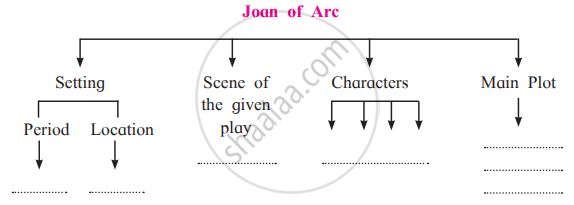
Say why? Write it in your notebook.
Poulengey, Jack and Dick had offered to accompany Joan.
Say why? Write it in your notebook.
French soldiers were always beaten in war.
Discuss in groups/pairs and make a list of the weapons used in the old times and in the present times.
| Weapons used in the past | Weapons used nowadays |
Say WHY?
Joan wanted to meet the Captain squire.
Say WHY?
Joan did not ask for many soldiers from the Captain squire.
Say WHY?
Captain squire Robert said, “I wash my hands off it.”
Match the comparisons as given in the extract.
| 1. | as easy as ............. | a. | like sheep |
| 2. | as mad as ............. | b. | like a rat in the corner |
| 3. | drive the soldiers ............. | c. | a bit of a miracle |
| 4. | The Dauphin is ............. | d. | as she is |
| 5. | Joan of Arc is ............. | e. | the steward |
| f. | chasing a cow |
