Advertisements
Advertisements
प्रश्न
Refer to the diagram alongside and answer the following questions:
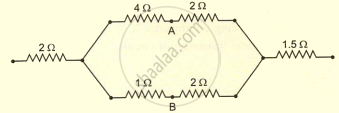
- Resistance of the wing marked as A.
- Resistance of the wing marked as B.
- Equivalent resistance of A and B.
- Equivalent resistance of the whole circuit.
Advertisements
उत्तर
(i) Resistance of wing A: \[ \mathrm{R}_{A} = 2 \ \Omega + 3 \ \Omega = 5 \ \Omega \]
(ii) Resistance of wing B: \[ \mathrm{R}_{B} = 4 \ \Omega + 6 \ \Omega = 10 \ \Omega \]
(iii) Equivalent resistance of A and B in parallel:
\[ \frac{1}{\mathrm{R}_{p}} = \frac{1}{\mathrm{R}_{A}} + \frac{1}{\mathrm{R}_{B}} \]
\[ \frac{1}{\mathrm{R}_{p}} = \frac{1}{5} + \frac{1}{10} \]
\[ \frac{1}{\mathrm{R}_{p}} = \frac{2}{10} + \frac{1}{10} \]
\[ \frac{1}{\mathrm{R}_{p}} = \frac{3}{10} \]
\[ \mathrm{R}_{p} = \frac{10}{3} \ \Omega \]
\[ \mathrm{R}_{p} = \approx 3.33 \ \Omega \]
(iv) Equivalent resistance of the whole circuit:
The parallel combination is in series with the outer resistors 1 Ω and 2 Ω. \[ \mathrm{R}_{total} = 1 \ \Omega + \frac{10}{3} \ \Omega + 2 \ \Omega \]
\[ \mathrm{R}_{total} = 3 \ \Omega + \frac{10}{3} \ \Omega \]
\[ \mathrm{R}_{total} = \frac{9}{3} \ \Omega + \frac{10}{3} \ \Omega \]
\[ \mathrm{R}_{total} = \frac{19}{3} \ \Omega \]
\[ \mathrm{R}_{total} \approx 6.33 \ \Omega \]
