Advertisements
Advertisements
प्रश्न
Radioactive substances were found to give off three types of rays. Name them. How do they
(a) React to the magnetic field?
(b) React to the electric field?
(c) Act when different thickness of lead sheets is placed in their path?
Advertisements
उत्तर
A radioactive source emits three types of radiations. These are a
radiations, β radiations and γ radiations.
(i) α particles are heavy in mass and have positive charge so they are less deflected by magnetic field. β particles are Iighter in mass and have negative charge so they are deflected mo re by magnetic field in opposite direction to a particle's deflection. γ radiations are charge less and mass less so they are not deflected by magnetic field.
(ii) a particles are heavy in mass and have positive charge so they are less deflected by electric field towards negative plate. β particles are Iighter in mass and have negative charge so they are deflected mo re by electric field towards positive plate. γ radiations are charge less and mass less so they are not deflected by electric field.
(iii) The penetrating power of a particle is least. They can't penetrate lead sheet very much. Penetrating power of β particles is less but 100 times mo re than that of a particle. So, it will penetrate lead sheet more than a particles. γ radiations have maximum penetration power. They are 100 times more penetrating than β particles. So, γ radiations wouId penetrate in lead sheet by larqest amount.
APPEARS IN
संबंधित प्रश्न
When does the nucleus of an atom tend to become radioactive?
Give the relative ionizing power of α, β and γ radiations.
What kind of change takes place in a nucleus when a β -particle is emitted?
In following fig. shows a mixed source S of alpha and beta particles in a thick lead container. The particles pass through a magnetic field in a direction perpendicular to the plane of paper (inwards as shown by x). State and show in the diagram how the particles get affected.

In the following fig. shows a radioactive source S in a thick lead container. The radiations pass through an electric field between the plates P and Q. Complete the diagram to show the paths of α , β and γ radiations.
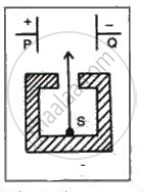
Why is the source S placed in a thick lead container?
Mention one important function of ear main parts:
State the principle on which the functioning of a nuclear reactor is based.
A radioactive material decays by simultaneous emissions of two particles with half-lives of 1400 years and 700 years respectively. What will be the time after which one-third of the material remains? (Take In3 = 1.1)
Which type of radioactive emission is strongly ionising in nature?
