Advertisements
Advertisements
प्रश्न
Prove that the bisectors of opposite angles of a parallelogram are parallel.
Advertisements
उत्तर
Given ABCD is a parallelogram. The bisectors of ∠ADC and ∠BCD meet at E. The bisectors of ∠ABC and ∠BCD meet at F
From the parallelogram ABCD we have
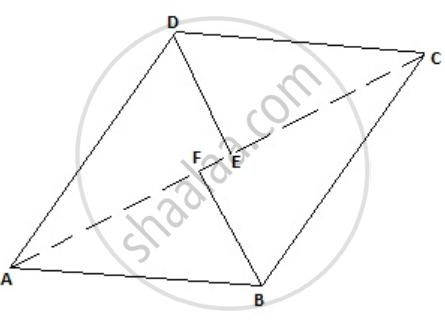
∠ADC + ∠BCD = 180° ...[ sum of adjacent angles of a parallalogram ]
⇒ `("∠ADC")/(2) + ("∠BCD")/(2)` = 90°
⇒ ∠EDC + ∠EDC = 90°
In triangle ECD sum of angles = 180°
⇒ ∠EDC + ∠ECD + ∠CED = 180°
= ∠CED = 90°
Similarly taking triangle BCF it can prove that ∠BFC = 90°
Now since
∠BFC = ∠CED = 90°
Therefore the lines DE and BF are parallel
Hence proved
APPEARS IN
संबंधित प्रश्न
The diagonal BD of a parallelogram ABCD bisects angles B and D. Prove that ABCD is a rhombus.
The alongside figure shows a parallelogram ABCD in which AE = EF = FC.
Prove that:
- DE is parallel to FB
- DE = FB
- DEBF is a parallelogram.

The following figure shows a trapezium ABCD in which AB is parallel to DC and AD = BC. 
Prove that:
(i) ∠DAB = ∠CBA
(ii) ∠ADC = ∠BCD
(iii) AC = BD
(iv) OA = OB and OC = OD.
Points M and N are taken on the diagonal AC of a parallelogram ABCD such that AM = CN. Prove that BMDN is a parallelogram.
PQRS is a parallelogram. T is the mid-point of PQ and ST bisects ∠PSR.
Prove that: QR = QT
ABCD is a parallelogram. The bisector of ∠BAD meets DC at P, and AD is half of AB.
Prove that: BP bisects ∠ABC.
ABCD is a parallelogram. The bisector of ∠BAD meets DC at P, and AD is half of AB.
Prove that: ∠APB is a right angle.
In a parallelogram ABCD, E is the midpoint of AB and DE bisects angle D. Prove that:CE is the bisector of angle C and angle DEC is a right angle
In the given figure, the perimeter of parallelogram PQRS is 42 cm. Find the lengths of PQ and PS.
In the Figure, ABCD is a rectangle and EFGH is a parallelogram. Using the measurements given in the figure, what is the length d of the segment that is perpendicular to `bar("HE")` and `bar("FG")`?
