Advertisements
Advertisements
प्रश्न
PQRS is a parallelogram. T is the mid-point of PQ and ST bisects ∠PSR.
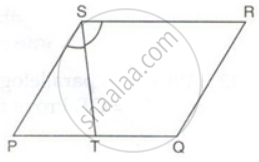
Prove that: ∠RTS = 90°
Advertisements
उत्तर

∠PST = ∠TSR
∠QRT = ∠TRS
∠QRS + ∠PSR = 180° ...(adjacent angles of || gm are supplementary)
Multiplying by `(1)/(2)`
`(1)/(2)∠"QRS" + (1)/(2)∠"PSR" = (1)/(2) xx x180°`
∠TSR + ∠TRS = 90°
In ΔSTR,
∠TSR + ∠RTS + ∠TRS = 180°
90° + ∠RTS = 180°
∠RTS = 90°.
APPEARS IN
संबंधित प्रश्न
The diagonal BD of a parallelogram ABCD bisects angles B and D. Prove that ABCD is a rhombus.
In the alongside diagram, ABCD is a parallelogram in which AP bisects angle A and BQ bisects angle B.

Prove that:
- AQ = BP
- PQ = CD
- ABPQ is a parallelogram.
In the given figure, ABCD is a parallelogram.
Prove that: AB = 2 BC.

Prove that the bisectors of opposite angles of a parallelogram are parallel.
ABCD is a parallelogram. The bisector of ∠BAD meets DC at P, and AD is half of AB.
Prove that: ∠APB is a right angle.
In a parallelogram ABCD, E is the midpoint of AB and DE bisects angle D. Prove that:CE is the bisector of angle C and angle DEC is a right angle
Find the perimeter of the parallelogram PQRS.

In the following figure, it is given that BDEF and FDCE are parallelograms. Can you say that BD = CD? Why or why not?

In the following figure, ABCD and AEFG are two parallelograms. If ∠C = 55º, determine ∠F.

Construct a parallelogram POUR in which, PO = 5.5 cm, OU = 7.2 cm and ∠O = 70°.