Advertisements
Advertisements
प्रश्न
Prove that `(1 + sin θ)/(1 - sin θ) = (sec θ + tan θ)^2`.
Advertisements
उत्तर
L.H.S. = `(1 + sin θ)/(1 - sin θ)`
= `((1 + sinθ)/(cosθ))/((1 - sinθ)/(cosθ))` ...[Dividing numerator and denominator by cos θ]
= `(1/cosθ + (sinθ)/(cosθ))/(1/cosθ - (sinθ)/(cosθ)`
= `(secθ + tanθ)/(secθ - tanθ)`
= `(secθ + tanθ)/(secθ - tanθ) xx (secθ + tanθ)/(secθ + tanθ)` ...[On rationalising the denominator]
= `(secθ + tanθ)^2/(sec^2θ - tan^2θ)`
= `(secθ + tanθ)^2/1` ...`[(∵ 1 + tan^2θ = sec^2θ),(∴ sec^2θ - tan^2θ = 1)]`
= (sec θ + tan θ)2
= R.H.S.
∴ `(1 + sinθ)/(1 - sinθ) = (sec θ + tan θ)^2`
APPEARS IN
संबंधित प्रश्न
If secθ + tanθ = p, show that `(p^{2}-1)/(p^{2}+1)=\sin \theta`
Prove the following trigonometric identities:
`(1 + tan^2 theta)/(1 + cot^2 theta) = ((1 - tan theta)/(1 - cot theta))^2 = tan^2 theta`
Prove the following trigonometric identity:
`sqrt((1 + sin A)/(1 - sin A)) = sec A + tan A`
Prove the following trigonometric identities.
(cosec θ − sec θ) (cot θ − tan θ) = (cosec θ + sec θ) ( sec θ cosec θ − 2)
Prove the following identities:
`(sec A - 1)/(sec A + 1) = (1 - cos A)/(1 + cos A)`
Prove the following identities:
(cosec A – sin A) (sec A – cos A) (tan A + cot A) = 1
If sin A + cos A = m and sec A + cosec A = n, show that : n (m2 – 1) = 2 m
Prove the following identities:
`(1 - 2sin^2A)^2/(cos^4A - sin^4A) = 2cos^2A - 1`
Prove the following identities:
sec4 A (1 – sin4 A) – 2 tan2 A = 1
`tan theta /((1 - cot theta )) + cot theta /((1 - tan theta)) = (1+ sec theta cosec theta)`
If `m = (cos θ - sin θ)` and `n = (cos θ + sin θ)`, show that `sqrt(m/n) + sqrt(n/m) = 2/sqrt(1 - tan^2θ)`.
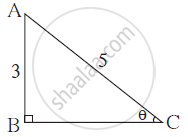
From the figure find the value of sinθ.
If \[\cos A = \frac{7}{25}\] find the value of tan A + cot A.
Prove the following identity :
`cosA/(1 - tanA) + sinA/(1 - cotA) = sinA + cosA`
If cosθ = `5/13`, then find sinθ.
Prove that `((tan 20°)/(cosec 70°))^2 + ((cot 20°)/(sec 70°))^2 = 1`
Prove that: `(1 + cot^2 θ/(1 + cosec θ)) = cosec θ`.
sec 60° = ?
Prove that cot2θ – tan2θ = cosec2θ – sec2θ.
Prove that sec2θ – cos2θ = tan2θ + sin2θ.
