Advertisements
Advertisements
प्रश्न
Prove the following by using the principle of mathematical induction for all n ∈ N: 1.2.3 + 2.3.4 + … + n(n + 1) (n + 2) = `(n(n+1)(n+2)(n+3))/(4(n+3))`
Advertisements
उत्तर
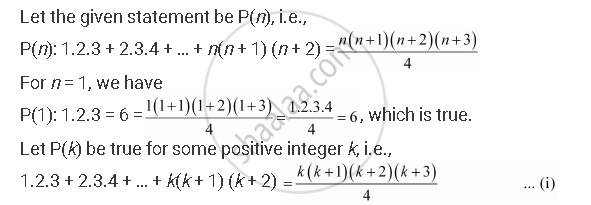
We shall now prove that P(k + 1) is true.
Consider
1.2.3 + 2.3.4 + … + k(k + 1) (k + 2) + (k + 1) (k + 2) (k + 3)
= {1.2.3 + 2.3.4 + … + k(k + 1) (k + 2)} + (k + 1) (k + 2) (k + 3)
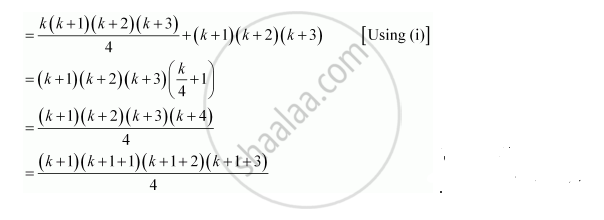
Thus, P(k + 1) is true whenever P(k) is true.
Hence, by the principle of mathematical induction, statement P(n) is true for all natural numbers i.e., n.
संबंधित प्रश्न
Prove the following by using the principle of mathematical induction for all n ∈ N:
1.2 + 2.3 + 3.4+ ... + n(n+1) = `[(n(n+1)(n+2))/3]`
Prove the following by using the principle of mathematical induction for all n ∈ N:
Prove the following by using the principle of mathematical induction for all n ∈ N:
(1+3/1)(1+ 5/4)(1+7/9)...`(1 + ((2n + 1))/n^2) = (n + 1)^2`
Prove the following by using the principle of mathematical induction for all n ∈ N:
`1/1.4 + 1/4.7 + 1/7.10 + ... + 1/((3n - 2)(3n + 1)) = n/((3n + 1))`
Prove the following by using the principle of mathematical induction for all n ∈ N: 102n – 1 + 1 is divisible by 11
Given an example of a statement P (n) such that it is true for all n ∈ N.
1 + 2 + 3 + ... + n = \[\frac{n(n + 1)}{2}\] i.e. the sum of the first n natural numbers is \[\frac{n(n + 1)}{2}\] .
12 + 22 + 32 + ... + n2 =\[\frac{n(n + 1)(2n + 1)}{6}\] .
\[\frac{1}{1 . 4} + \frac{1}{4 . 7} + \frac{1}{7 . 10} + . . . + \frac{1}{(3n - 2)(3n + 1)} = \frac{n}{3n + 1}\]
\[\frac{1}{2} + \frac{1}{4} + \frac{1}{8} + . . . + \frac{1}{2^n} = 1 - \frac{1}{2^n}\]
52n −1 is divisible by 24 for all n ∈ N.
n(n + 1) (n + 5) is a multiple of 3 for all n ∈ N.
11n+2 + 122n+1 is divisible by 133 for all n ∈ N.
Prove that 1 + 2 + 22 + ... + 2n = 2n+1 - 1 for all n \[\in\] N .
Let P(n) be the statement : 2n ≥ 3n. If P(r) is true, show that P(r + 1) is true. Do you conclude that P(n) is true for all n ∈ N?
\[\frac{(2n)!}{2^{2n} (n! )^2} \leq \frac{1}{\sqrt{3n + 1}}\] for all n ∈ N .
\[\text{ Let } P\left( n \right) \text{ be the statement } : 2^n \geq 3n . \text{ If } P\left( r \right) \text{ is true, then show that } P\left( r + 1 \right) \text{ is true . Do you conclude that } P\left( n \right)\text{ is true for all n } \in N?\]
Show by the Principle of Mathematical induction that the sum Sn of then terms of the series \[1^2 + 2 \times 2^2 + 3^2 + 2 \times 4^2 + 5^2 + 2 \times 6^2 + 7^2 + . . .\] is given by \[S_n = \binom{\frac{n \left( n + 1 \right)^2}{2}, \text{ if n is even} }{\frac{n^2 \left( n + 1 \right)}{2}, \text{ if n is odd } }\]
Prove by method of induction, for all n ∈ N:
2 + 4 + 6 + ..... + 2n = n (n+1)
Prove by method of induction, for all n ∈ N:
12 + 22 + 32 + .... + n2 = `("n"("n" + 1)(2"n" + 1))/6`
Prove by method of induction, for all n ∈ N:
13 + 33 + 53 + .... to n terms = n2(2n2 − 1)
Prove by method of induction, for all n ∈ N:
1.3 + 3.5 + 5.7 + ..... to n terms = `"n"/3(4"n"^2 + 6"n" - 1)`
Prove by method of induction, for all n ∈ N:
3n − 2n − 1 is divisible by 4
Answer the following:
Prove by method of induction
`[(3, -4),(1, -1)]^"n" = [(2"n" + 1, -4"n"),("n", -2"n" + 1)], ∀ "n" ∈ "N"`
Answer the following:
Prove by method of induction loga xn = n logax, x > 0, n ∈ N
The distributive law from algebra says that for all real numbers c, a1 and a2, we have c(a1 + a2) = ca1 + ca2.
Use this law and mathematical induction to prove that, for all natural numbers, n ≥ 2, if c, a1, a2, ..., an are any real numbers, then c(a1 + a2 + ... + an) = ca1 + ca2 + ... + can.
Prove by the Principle of Mathematical Induction that 1 × 1! + 2 × 2! + 3 × 3! + ... + n × n! = (n + 1)! – 1 for all natural numbers n.
Let P(n): “2n < (1 × 2 × 3 × ... × n)”. Then the smallest positive integer for which P(n) is true is ______.
Prove the statement by using the Principle of Mathematical Induction:
n3 – 7n + 3 is divisible by 3, for all natural numbers n.
Prove the statement by using the Principle of Mathematical Induction:
For any natural number n, xn – yn is divisible by x – y, where x and y are any integers with x ≠ y.
Prove the statement by using the Principle of Mathematical Induction:
n(n2 + 5) is divisible by 6, for each natural number n.
Prove the statement by using the Principle of Mathematical Induction:
1 + 2 + 22 + ... + 2n = 2n+1 – 1 for all natural numbers n.
A sequence a1, a2, a3 ... is defined by letting a1 = 3 and ak = 7ak – 1 for all natural numbers k ≥ 2. Show that an = 3.7n–1 for all natural numbers.
Prove that `1/(n + 1) + 1/(n + 2) + ... + 1/(2n) > 13/24`, for all natural numbers n > 1.
If xn – 1 is divisible by x – k, then the least positive integral value of k is ______.
If P(n): 2n < n!, n ∈ N, then P(n) is true for all n ≥ ______.
State whether the following statement is true or false. Justify.
Let P(n) be a statement and let P(k) ⇒ P(k + 1), for some natural number k, then P(n) is true for all n ∈ N.
