Advertisements
Advertisements
प्रश्न
Prepare a Fact file of any of the following plants/trees, using the points given.
[coconut / neem / basil / cactus / apple]
- Name of Plant/Tree _________
- Scientific name ___________
- Region and climate ___________
- Features ___________
- Growth _____________
- Size, shape and colour ____________
- Uses __________
- Any special feature ________
Advertisements
उत्तर
Profile of the Coconut Tree and Fruit
- Names:
English name Coconut;
Sanskrit name - Narikela;
Hindi name - Nariyal. - Scientific name:
cocos nucifera; belongs to the family 'Palmae' or the palm family (also known as Arecaceae). - Region and Climate:
Tropical and sub tropical coastal regions, especially near sea beaches. - Features:
i. Fruit: has a thick fibrous coir over the hard shell: inside the kernel colourless liquid;
ii. leaves: feather-shaped and split into lots of leaflets. - Growth:
Coconut trees can grow from 15 to 30 metres in height in plantations - Size and shape:
Coconut fruits are oval in shape. The trunk of the coconut tree is ringed with scars where old leaves have fallen. The top of the trunk is crowned with a rosette of leaves. The leaves can grow up to 7 feet long and can have 250 leaflets. - Uses:
i. Coir weaving and leaves: matting, thatching and
ii. Hard outer shell: about 10 to 15 inches in length: used to make articles such as spoons, eating utensils, charcoal, etc.
iii. Inside of the shell: lined with a white edible layer called the meat: used for cooking or extraction of oil, making of soaps or cosmetics: also to make chemical Industrial and medicinal products: contains coconut water which is very nutritious.
iv. Husk and leaves: used as material to make a variety of products for furnishing and decorating - Any special feature:
Known in India as kalpavriksha' or the tree of heaven' because of its many uses: the term coconut is derived from the 16th century Portuguese and Spanish. meaning grinning face from the three small holes on the coconut shell that resemble human facial features.
APPEARS IN
संबंधित प्रश्न
What things in nature teach us the following:
Nothing is impossible to achieve ____________.
What things in nature teach us the following:
Problems are not permanent ___________.
Read the question from the lesson. What do they imply?
Are you listening?
Go through the lesson again and complete the flow-chart that highlights the life of a ‘hibiscus’ flower.

Think and answer in your own words.
How should you deal with difficulties and problems?
Think and answer in your own words.
‘An oyster turns a grain of sand into a pearl.’ What can we learn from this example?
Think and answer in your own words.
How does nature succeed in its ‘Alchemy’? What can it turn a small person into?
Look at the following thing. Discuss with your friend, what you learn from them.
A bee
Look at the following things. Discuss with your friend, what you learn from them.
The river
Read the following passage and do the activities:
A1. Complete the following web:
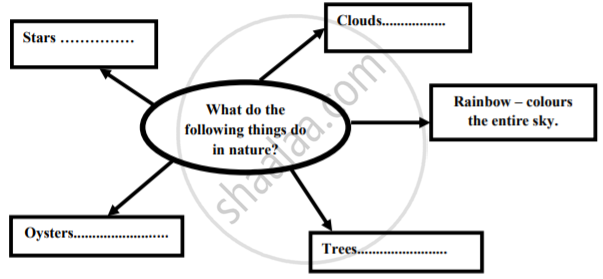
We saw small bits of grass peeping through the small cracks in the concrete pavement. It left us thinking: however impossible things may look, there is always an opening......
We saw a tree bare of all leaves in the cold winter months. We thought its chapter was over. But three months passed, spring set in, and the tree was back to its green majesty once again, full of leaves, flowers, birds, and life. What if we too had the conviction that, however difficult things are right now, it will not remain so forever. Remember, this too shall pass.
We saw an army of ants lugging a fly which was at least ten times the ant’s size. The ants organized themselves around the fly, lifted it on frail feelers, and carried it to quite a distance. Their teamwork and perseverance were impressive. What if we too are consistent, organized focused.......
Spider webs are delicate, yet very strong. A rainbow colours the entire sky. Oysters take in a grain of sand they open up with a pearl. Innumerable stars shine across the infinite sky. Clouds take new shapes with every passing moment. The wind makes trees dance with unhindered passion. Water, without a hint of ego, changes its form according to the dictates of the sun and the wind. When we see a caterpillar turn into a butterfly, a flower turns into a fruit, we experience the alchemy of nature… we touch it and become gold ourselves.
A2. What do the following things in nature teach us: (02)
- Ants ______
- Grass ______
A3. Complete the following collocations with the help of the passage: (02)
- ............... winter
- ................... moment
- ………….passion
- ……………. sky
A4. Do as directed:
- Spider webs are delicate, yet very strong. (02)
(Rewrite the sentence beginning with ‘Although ..........’) - We touch it and become gold ourselves.
(Add a question tag and Rewrite the sentence)
A5. How do you deal with difficulties and problems in life? Explain in brief. (02)
