Advertisements
Advertisements
प्रश्न
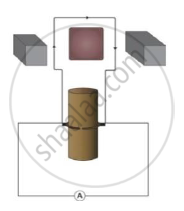
Observe the following diagram and answer the questions.

- Explain the construction of the equipment shown in the figure.
- How is AC generated?
Advertisements
उत्तर
- An AC generator consists of a rotating rectangular coil ABCD placed between the two poles of a permanent magnet. The coil is attached to the two rings R1 and R2 at both ends. The two stationary conducting brushes B1 and B2 are maintained and pushed independently on the corresponding rings R1 and R2.
The coil inside the magnetic field can be rotated mechanically from the outside by turning the two internal rings R1 and R2, which are coupled to an axle. The galvanometer is linked to the two brushes' outer ends to display the direction of current flow in the specified external circuit. - According to Fleming's right-hand rule, the current is induced in these arms in the direction ABCD. After half rotation, arm CD moves down and arm AB moves up. As a result, each segment's current flow switches direction, resulting in net-induced current flowing in the direction of DCBA. As a result, the polarity of the current in each arm changes after every turn, producing an alternating current.
APPEARS IN
संबंधित प्रश्न
State the principle of an electric generator.
Name some sources of direct current.
The device used for producing electric current is called a ______.
State whether the following statement is true or false.
An electric motor converts mechanical energy into electrical energy.
What is the function of brushes in an electric generator?
Why are Thermal Power Stations usually located near a river?
Explain the principle of an electric generator.
What determines the frequency of a.c. produced in a generator?
What energy conversion does take place in a generator when it is in use?
Explain the difference:
AC generator and DC generator.
Observe the figure and answer the following questions.
a) Identify the machine shown in figure.
b) Write a use of this machine.
c) How transformation of energy takes place in this machine.
A flat coil of wire rotates at a constant speed about an axis perpendicular to a uniform magnetic field. Draw a graph to show how the induced e.m.f. varies relative to the positions of the coil during its one complete rotation. At what position of the coil, the e.m.f. has the maximum value?
State true or false:
The frequency of AC is 50 Hz.
The part of the AC generator that passes the current from the armature coil to the external circuit is ______.
What energy conversion takes place in an a.c. generator?
Under what condition is an EMF induced in a closed coil?
Which are listed as sources of mechanical energy supplied to the rotor shaft?
What is the peak EMF of the rotating coil?
What is the frequency of rotation of the stationary-bicycle generator's coil?
What voltage range is given as an example for generators in real power stations?
