Advertisements
Advertisements
प्रश्न
Mention two features of monopoly.
Explain three main features of monopoly.
State two important characteristics of monopoly.
Explain the main characteristics of a monopoly.
State three main features of a monopoly market.
Explain one feature of a monopoly market.
Explain the important characteristics (features) of a monopoly market.
Discuss four main features of a monopoly market.
State any three main characteristics of monopoly.
Discuss two features of monopoly.
Explain any three features of monopoly.
Explain the features of a monopoly market.
Advertisements
उत्तर
- Single seller and large number of buyers: Under monopoly, there is only one seller or firm or manufacturer of a commodity. The product sold by the monopolist may or may not be homogeneous. The existence of a single seller of one product eliminates the difference between the firm and the industry. There can be any number of buyers under a monopoly.
- No Close Substitutes: A second feature of monopoly is that there are no close substitutes available for the product sold by the monopolist. A pure monopoly exists only when there is no close substitute for the product sold by the monopolist. Indian Railways is another example of a monopoly.
- Restriction on the Entry of New Firms: Under monopoly, new firms cannot enter the industry. There are strong barriers that prevent new firms from entering the industry. These barriers may take several forms, such as patent rights government licenses, economies of scale, etc. Thus, a monopolist faces no competition and earns abnormal profit in the long run.
- Firm is a Price-Maker: Due to strong barriers to the entry of new firms into the industry, the monopoly firm has full control over the supply of its product. Therefore, it has full control over its price, too. It can influence the market price by varying its supply.
- Price Discrimination: The act of selling the same product at different prices to different buyers is known as price discrimination. A monopolist can charge different prices to his different buyers easily. If a monopolist adopts a policy of price discrimination, the situation is called a discriminating monopoly.
Notes
Students should refer to the answer according to their question.
APPEARS IN
संबंधित प्रश्न
When products are differentiated on the basis of advertisements, brand names etc., it is called as ______.
Selling costs are absent in perfect competition market.
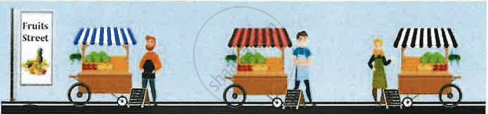
“While shopping for fruits in the local market you see many seller selling fruits”. In this context answer the following:
- What is the type of market referred to?
- State and draw the type of demand curve faced by the market above.
- Differentiate between the market indicated above and monopoly on the basis of:
- No. of sellers
- Market price
- Entry and exit of firms in the market
Following is not the feature of perfect competition:
Differentiated products is a characteristic of ______.
A market where homogeneous products are sold with no control over price by an individual firm or a buyer is ______.
The seller in a monopoly market is a price maker.
Pick the option which does not belong to the group.
Match the following:
| Column I | Column II | ||
| A. | Monopoly | (i) | Availability of close substitutes |
| B. | Oligopoly | (ii) | Absence of close substitutes |
| C. | Perfect competition | (iii) | Few large sellers |
| D. | Monopolistic competition | (iv) | Homogeneous products |
Define product differentiation.
To which market is product differentiation relevant?
State the advantage of monopolistic competition over monopoly.
Why is there no need for selling cost under perfect competition?
In which form of market is the seller a price taker? Justify your answer.
Identify the market form of the following:
Market for toilet soaps in India.
Identify the market form for the following:
Perfectly elastic demand.
Identify the market form for the following:
Telecom industry in India.
State the market form of the following commodity.
Railways
State the market form of the following commodity.
Automobiles
State the market form of the following commodity.
Fighter Aircrafts
Name the market in which there is a single buyer and many sellers. Give an example.
Define monopoly.
Which type of market structure is the following? Give reason.
Lipstick
Give two examples of a monopolistically competitive market.
What is meant by the term ‘price taker’?
What is the effect on price when a monopoly firm tries to sell more?
Elaborate the price discrimination feature of monopoly.
There is inverse relation between price and demand for the product of a firm under ______.
Why do producers incur high selling costs in an imperfect market?
Name the characteristic which makes monopolistic competition different from perfect competition.
What is a price making firm?
In which market form is there a single seller and no close substitutes for the product?
