Advertisements
Advertisements
प्रश्न
Medically it is advised to all young mothers that breast-feeding is the best for their newborn babies. Do you agree? Give reasons in support of your answer.
Advertisements
उत्तर १
Yes, breast-feeding is very important for newborn babies. The milk produced during the initial few days of lactation called colostrum is a rich source of antibodies and has balanced nutrient content which is extremely beneficial for the newborn babies. The benefits of breast-feeding are:
- It consists of several antibodies which protect the baby from external viral and bacterial infections.
- It has a calorific value of 70 per 100 ml of milk which meets the requirement of the infants.
- It is available at a correct temperature and proportion for the baby.
उत्तर २
- Yes, I do agree with the fact that breast-feeding is the best for newborn babies.
- Mammary glands start producing milk at the end of pregnancy. The milk produced during the initial few days and lactation is called COLOSTRUM which contains several antibodies.
- It helps in developing resistance for the newborn baby. It helps the baby fight of viruses and bacteria.
- Thus breast milk is packed with the disease-fighting substance that protects your baby from illness.
- Breast milk also naturally contains many of the vitamins and minerals that a newborn requires.
- Also, it is easily digested-no constipation, diarrhoea and upset stomach.
APPEARS IN
संबंधित प्रश्न
Comment on the role of placenta as an endocrine gland.
Explain Rh factor incompatibility during pregnancy.
The first movements of the foetus and appearance of hair on its head are usually observed during which month of pregnancy?
To answer the question, study the graphs below for Subjects 1 and 2 showing different levels of certain hormones.
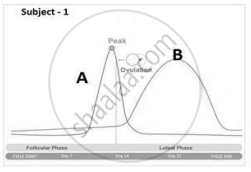
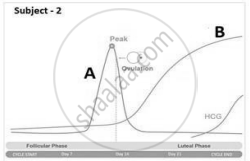
Subject 2 has a higher level of hormone B, which is ______
Which of the following is not a function of the placenta?
Explain the phases in embryonic development from the morula stage till the establishment of pregnancy in a human female.
At what point during pregnancy is the embryo officially referred to as a fetus?
By the end of 24 weeks (end of second trimester), what fine hair covering the fetus is called?
Which hormone prepares the mammary glands for lactation and promotes fetal growth?
Which maternal hormones increase several-fold during pregnancy to support fetal growth and metabolic changes?
