Advertisements
Advertisements
प्रश्न
Match the classes of drugs given in Column I with their action given in Column II.
| Column I | Column II |
| (i) Analgesics | (a) Inhibit the growth of microorganisms can be given orally |
| (ii) Antiseptics | (b) Treatment of stress |
| (iii) Antihistamines | (c) Applied to inanimate objects |
| (iv) Antacids | (d) Prevents the interaction of histamine with its receptor |
| (v) Tranquilisers | (e) Pain killing effect |
| (vi) Antibiotics | (f) Applied to diseased skin surfaces |
| (vii) Disinfectants | (g) Treatment of acidity |
Advertisements
उत्तर
| Column I | Column II |
| (i) Analgesics | (e) Pain killing effect |
| (ii) Antiseptics | (f) Applied to diseased skin surfaces |
| (iii) Antihistamines | (d) Prevents the interaction of histamine with its receptor |
| (iv) Antacids | (g) Treatment of acidity |
| (v) Tranquilisers | (b) Treatment of stress |
| (vi) Antibiotics | (a) Inhibit the growth of microorganisms can be given orally |
| (vii) Disinfectants | (c) Applied to inanimate objects |
Explanation:
(i) Analgesics reduce or abolish pain without causing impairment of consciousness, mental confusion, in coordination or paralysis or some other disturbances of nervous system, e.g., aspirin.
(ii) Antiseptics are the chemicals that either kill or prevent the growth of microorganisms. They are applied to living tissues such as wounds, cuts etc. e.g., tincture of iodine.
(iii) Antihistamines are anti-allergic drugs. These drugs interfere with the natural action of histamine by competing with histamine for binding sites of receptor where histamine exerts its effect, e.g., seldane.
(iv) Antacids are used to neutralize excess of acid released in stomach e.g., mixture of \[\ce{Mg(OFl)2}\] and \[\ce{Al(OH)3}\].
(v) Tranquilizers are used for the treatment of stress, and mid or even severe mental diseases e.g., equanil.
(vi) Antibiotics are antimicrobial drugs. Antibiotics are used as drugs to treat infections because of their low toxicity for humans and animals e.g., chloramphenicol.
(vii) Disinfectants are the chemicals that either kill or prevent the growth of microorganisms but they can be applied on non-living objects e.g., 1 per cent solution of phenol.
APPEARS IN
संबंधित प्रश्न
Name a substance which can be used as an antiseptic as well as disinfectant.
What are the main constituents of dettol?
Compound which is added to soap to impart antiseptic properties is ______.
Which of the following are sulpha drugs?
(i) Sulphapyridine
(ii) Prontosil
(iii) Salvarsan
(iv) Nardil
What are antiseptics?
What is the harmful effect of hyperacidity?
What is the commonality between the antibiotic arsphenamine and azodye?
Assertion: Sulpha drug contain sulphonamide group.
Reason: Salvarsan is a sulpha drug.
Which of the following is known as broad spectrum antibiotics?
Barbituric acid is used as:-
Which statement is false?
SLV – 3 Rockets use
How many of the following drugs is/are example(s) of broad spectrum antibiotic?
The structure shown below is of which well-known drug molecule-
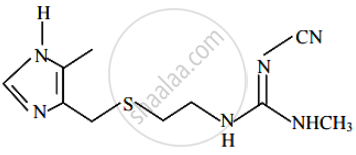
Which of the following was the first antiseptic used in surgery?
Which one of the following is an inorganic antiseptic?
Which of the following was the first synthetic antimicrobial drug?
What is the major advantage of using chloroxylenol based antiseptics?
Which of the following is a commonly used disinfectant in hospitals?
