Advertisements
Advertisements
प्रश्न
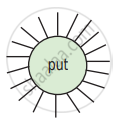
Look up the following verbs in a good dictionary. List at least 20 different uses of the following. You may include their use with different prepositions, adverbs, and idioms.
Advertisements
उत्तर
Uses of ‘put’:
- To place in a certain position or situation:
When did the Russians first put a man into space? - To submit or present (a proposal, question, etc):
I put several questions to him. - To express in words:
Children sometimes have such a funny way of putting things! - To write down:
I’m trying to write a letter to her, but I don’t know what to put. - To sail in a particular direction:
The ship was put into harbour for repairs. - To attribute: assign; ascribe:
She put the blame on me. - To impose:
The government put a tax on luxuries. - To make someone do something:
Sushant put his dog through its tricks. - To bring in or add; introduce; inject:
Avinash is excellent at putting life into a party. - To bring about; effect:
My father believes in putting a stop to cheating. - To postpone:
The meeting was put off until Monday. - To wear:
Please put on your coat. - To remove and store:
Put away your toys after playing - To tolerate:
I can't put up with this noise anymore. - To erect or build:
They are putting up a new school building. - To extinguish:
Please put out the fire before leaving. - To return to its place:
Put the books back on the shelf. - To suggest or propose:
She put forward a new plan. - To assemble or combine:
He put together a beautiful model aeroplane. - To save for future use:
She puts aside some money every month.
APPEARS IN
संबंधित प्रश्न
Fill in the blank with comparative, superlative, and positive forms of the correct adjective in the bracket.
He is the _______________ boy in class. (forgetful)
Change the voice in the following sentence.
Hardy was bored by that manuscript.
List at least 10 verbs, the last letter of which is doubled in the past participle.
Example: write - written
Use the words given below in your own sentences so as to get different meanings. One is done for you.
| cricket | Cricket is a popular sport. |
| Cricket is active at night. | |
| bank | |
| will | |
| bark | |
| watch | |
| bat | |
List out the transitive and intransitive verbs in the following words.
come, buy, teach, learn, arrive, sing, run, draw, jump, write.
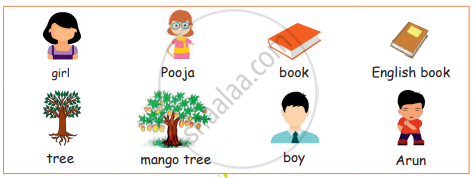
Circle the pictures that denotes person or things in common.
Write

______ unicorn
Change the following sentence into Active Voice.
You are requested to make a cup of tea for the guest
This narrative is written in the first person - using ‘I’. Rewrite the following sentence using ‘Helen Keller/Young Helen’ appropriately in place of ‘I’ and making other necessary changes in the sentence.
Then my eyes filled with tears; for I realised what I had done, and for the first time I felt repentance and sorrow.
