Advertisements
Advertisements
प्रश्न
Enlist and write in brief about the different biological tools required in rDNA technology.
Advertisements
उत्तर
The different biological tools required in rDNA technology:
i. Instruments: PCR, Agarose Gel Electrophoresis, SDS-PAGE
Polymerase Chain Reaction (PCR) is the process of in vitro amplification of the gene of interest using a PCR machine.
- PCR can generate a billion copies of the desired segment of DNA or RNA, with high accuracy and specificity, in a few hours.
- The process of PCR is completely automated and involves automatic thermal cycles for denaturation and renaturation of double-stranded DNA.
- The device required for PCR is called a thermal cycler.
Requirements for polymerase chain reaction:
- DNA containing the desired segment to be amplified
- several molecules of four deoxyribonuclueoside triphosphates (dNTPs)
- excess of two primer molecules
- heat-stable DNA polymerase and
- appropriate quantities of Mg++ ions.
DNA replication through a polymerase chain reaction.
ii. Biological tools: Enzymes, Cloning Vectors, Competent host
Different enzymes used in rDNA technology are as follows: Lysozymes, Nucleases such as exonucleases, endonucleases, restriction endonucleases, DNA ligases, DNA polymerases, alkaline phosphatases, reverse transcriptase, etc.
- Enzymes that cut the phosphodiester bonds of polynucleotide chains are called nuclease.
- These are of two types- exonuclease and endonuclease.
- Exonucleases cut nucleotides from the ends of DNA strands whereas endonuclease cut DNA from within.
- The phosphodiester backbone at highly specific sites on both strands of the duplex is cut by these enzymes called restriction endonucleases or simply restriction enzymes.
- The restriction enzymes are thus the molecular scissors that are used to recognize and cut DNA at specific sequences.
- The sites recognized by them, are called recognition sequences or recognition sites.
- Different restriction enzymes found in different organisms recognize different nucleotide sequences and therefore cut DNA at different sites.
The following characteristic properties a cloning vector must possess in order to be used in rDNA technology:
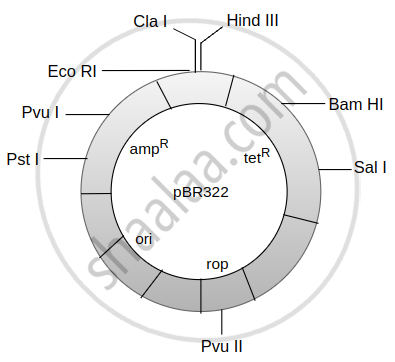
- A good vector should have the ability of independent replication so that as the vector replicates (through ori gene) and a large number of copies of the DNA insert will be formed.
- The vector should be able to easily introduce into host cells.
- A vector should have marker genes for antibiotic resistance.
- A vector must contain a unique cleavage site in one of the marker genes for the restriction enzyme.
- It should have at least suitable control elements like a promoter, operator, ribosomal binding sites, etc.
- The plasmids obtained naturally do not possess all the characteristics. Hence, they are constructed by inserting a gene for antibiotic resistance. e.g. pBR322, pBR320, pACYC177 are the constructed plasmids. pBR322 is mostly used in rDNA technology in plants.
Competent hosts (cloning organisms) used are usually bacteria like Bacillus haemophilus, Helicobacter pylori, and E. coli. Mostly E. coli is used for the transformation with recombinant DNA.
APPEARS IN
संबंधित प्रश्न
What is the role of Taq-polymerase in PCR technology?
Bt-cotton shows adverse effect on the population of which butterfly?
Which of the following is an INCORRECT match?
______ is the soil bacterium that causes crown gall characterized by tumors in plants.
The gene transfer between unrelated plants is brought about by ____________.
Human insulin is produced by culturing the genetically engineered ______
Who among the following was awarded the Nobel Prize for the development of PCR technique?
The given figure is the diagrammatic representation of the E. coli vector pBR322. Which one of the given options correctly indentites its certain component(s)?
Which of the following statements are true about cloning vectors?
- Vectors are DNA molecules that carry a foreign DNA segment.
- The replicated DNA is introduced into the host cell.
- It possesses the origin of replication (Ori).
- Vectors may be plasmid, bacteriophage, Yeast artificial chromosomes (YACs), etc.
- Vectors do not require a selectable marker to identify and eliminate non-transformants.
Choose the correct answer from the options given below.
Modern biotechnology is based on two core techniques. Which of the following correctly identifies both of these techniques?
