Advertisements
Advertisements
प्रश्न
Knee joint and elbow joint are examples of ______.
विकल्प
Saddle joint
Ball and socket joint
Pivot joint
Hinge joint
Advertisements
उत्तर
Knee joint and elbow joint are examples of hinge joint.
APPEARS IN
संबंधित प्रश्न
Name the type of joint between the following:
Between pubic bones in the pelvic girdle
What are the different types of joints? Give one example of each type.
Alongside is shown a diagrammatic skeletal of synovial j oint.
(a) What is a synovial joint?
(b) Where do you find such a joint?
(c) What is the function of cartilages?
(d) Name the parts 1 to 5. 2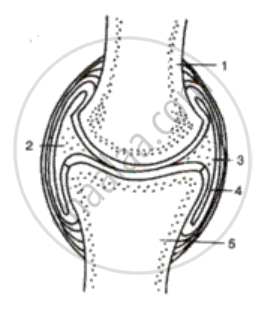
The question has four options. Choose the correct answer:
Which of the following is not true for the elbow joint?
Draw diagrams.
Types of joints
The place where two bones meet is termed as ______.
Joints of the bones help in the ______ of the body.
There are ______ types of movable joints.
Flat bones are seen in ______.
A bone is connected to another bone with a ______.
Name two joints with examples.
How are joints classified? Explain with an example.
Write the type of joint which is used for the following movement:
A person lifts weights to build up his biceps.
Which one of the following pairs is incorrect?
Give the location of a ball and socket joint in a human body.
Name the type of joint between the following:
Atlas/axis
Name the type of joint between the following:
Between cranial bones
Match List I with List II.
| List I | List II |
| A. Fibrous joints | I. Adjacent vertebrae, limited movement |
| B. Cartilaginous joints | II. Humerus and Pectoral girdle, rotational movement |
| C. Hinge joints | III. Skull, don’t allow any movement |
| D. Ball and socket joints | IV. Knee, help in locomotion |
Choose the correct answer from the options given below:
