Advertisements
Advertisements
प्रश्न
|
Khurja is a city in the Indian state of Uttar Pradesh famous for pottery. Khurja pottery is traditional Indian pottery work which has attracted Indians as well as foreigners with a variety of tea sets, crockery, and ceramic tile works. A huge portion of the ceramics used in the country is supplied by Khurja, which is also referred to as the ‘Ceramic Town’. One of the private schools of Bulandshahar organised an educational tour for class 10 students to Khurja. The given figure shows two pottery objects of Khurja. Students found the shapes of the objects very interesting and they could easily relate them with mathematical shapes like sphere, hemisphere, cylinder, etc. The internal radius of the hemispherical bowl in I is 9 cm and the radius and height of the cylindrical jar in II is 1.5 cm and 4 cm respectively.
|
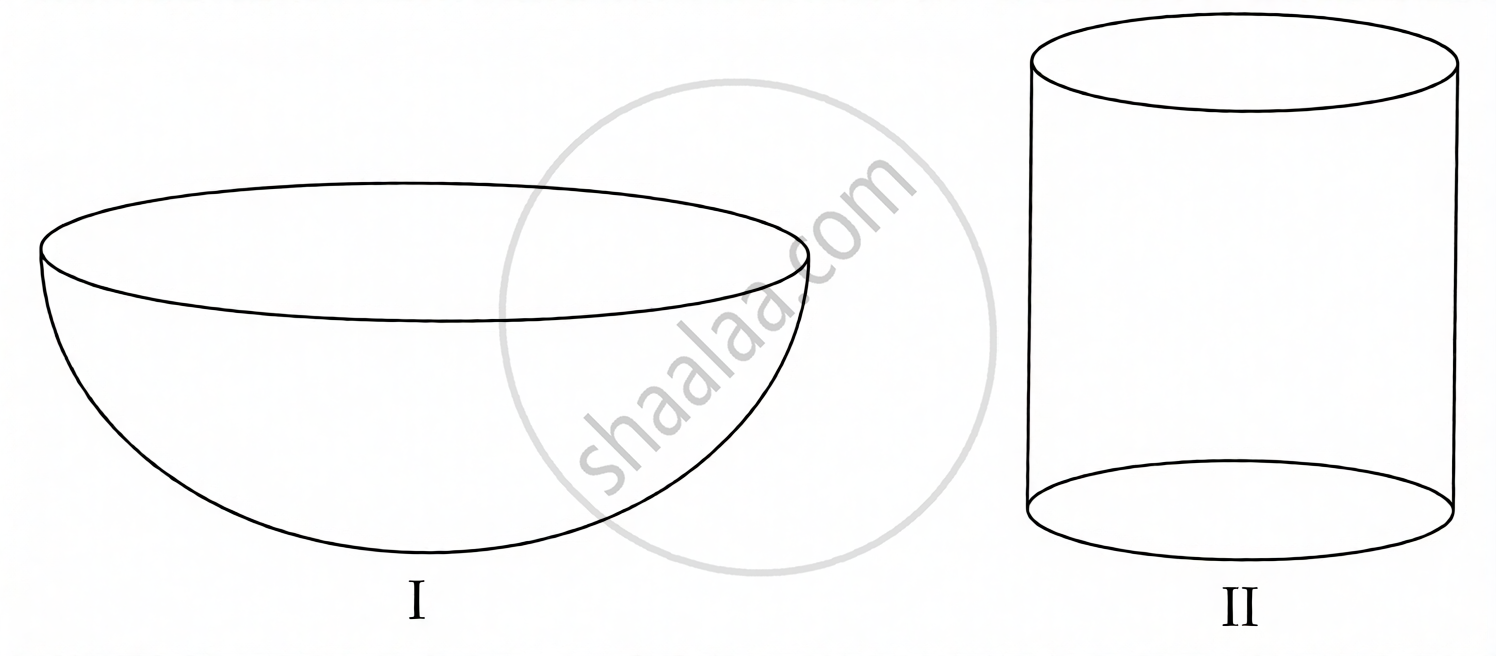
Based on the above information, answer the following questions.
- Find the capacity of the hemispherical bowl.
- Find the curved surface area of the cylindrical jar.
- If the hemispherical bowl (filled completely with water) is to be emptied into cylindrical jars then how many cylindrical jars are required?
- If in the cylindrical jar full of water, a conical funnel of same height and same diameter is immersed then how much water will flow out of the jar?
Advertisements
उत्तर
i. Capacity of the hemispherical bowl
Given: Radius of bowl, \[R = 9\text{ cm}\]
Formula: \[\text{Capacity} = \frac{2}{3}\pi R^3\]
Calculation: \[\text{Capacity} = \frac{2}{3} \times \frac{22}{7} \times 9^3\]
\[\text{Capacity} = \frac{2}{3} \times \frac{22}{7} \times 729 = \frac{10692}{7} \approx 1527.43\text{ cm}^3\]
ii. Curved surface area of the cylindrical jar
Given: Radius of cylindrical jar, \[r = 1.5\text{ cm}\]
Height, \[h = 4\text{ cm}\]
Formula: \[\text{CSA} = 2\pi rh\]
Calculation: \[\text{CSA} = 2 \times \frac{22}{7} \times 1.5 \times 4\]
\[\text{CSA} = \frac{264}{7} \approx 37.71\text{ cm}^2\]
iii. Number of cylindrical jars required
Calculation: \[\text{Number of jars} = \frac{\text{Volume of hemispherical bowl}}{\text{Volume of cylindrical jar}}\]
\[\text{Volume of bowl} = \frac{2}{3}\pi (9)^3 = 486\pi\text{ cm}^3\]
\[\text{Volume of jar} = \pi r^2 h = \pi (1.5)^2 (4) = 9\pi\text{ cm}^3\]
\[n = \frac{486\pi}{9\pi} = 54\]
Thus, 54 cylindrical jars are required.
iv. Volume of water that flows out
Given: By Archimedes' principle, the volume of water displaced is equal to the volume of the immersed conical funnel.
Formula: \[V = \frac{1}{3}\pi r^2 h\]
Calculation: \[V = \frac{1}{3} \times \frac{22}{7} \times (1.5)^2 \times 4\]
\[V = \frac{1}{3} \times \frac{22}{7} \times 2.25 \times 4 = \frac{66}{7} \approx 9.43\text{ cm}^3\]
