Advertisements
Advertisements
प्रश्न
It is a common observation that rain clouds can be at about a kilometre altitude above the ground.
- If a rain drop falls from such a height freely under gravity, what will be its speed? Also calculate in km/h. ( g = 10 m/s2)
- A typical rain drop is about 4mm diameter. Momentum is mass x speed in magnitude. Estimate its momentum when it hits ground.
- Estimate the time required to flatten the drop.
- Rate of change of momentum is force. Estimate how much force such a drop would exert on you.
- Estimate the order of magnitude force on umbrella. Typical lateral separation between two rain drops is 5 cm.
(Assume that umbrella is circular and has a diameter of 1 m and cloth is not pierced through !!)
Advertisements
उत्तर
Given, height (h) = 1 km = 100 m
g = 10 m/s2
a. Velocity attained by the raindrop in freely falling through a height h.
v = `sqrt(2gh)`
= `sqrt(2 xx 10 xx 1000)`
= `100sqrt(2)` m/s
= `100sqrt(2) xx (60 xx 60)/1000` km/h
= `360sqrt(2)` km/h ≈ 510 km/h
b. Diameter of the drop (d) = 2r = 4 mm
∴ Radius of the drop (r) = 2 mm = 2 × 10⁻³ m
Mass of a raindrop (m) = V × p
= `4/3 pir^3p`
= `4/3 xx 22/7 xx (2 xx 10^-3)^3 xx 10^3` .....(∵ Density of water = 103 kg/m3)
= 3.4 × 10⁻⁵ kg
The momentum of the raindrop (p) = mv
= `3.4 xx 10^-5 xx 100sqrt(2)`
= `4.7 xx 10^-3` kg-m/s
≈ `5 xx 10^-3` kg-m/s
c. Time required to fatten the drop = time taken by the drop to travel the distance equal to the diameter of the drop near the ground
`t = d/v`
= `(4 xx 10^3)/(100 sqrt(2))`
= ``0.028 xx 10^-3` s
= `2.8 xx 10^-5` s ≈ 30 ms
d. Force exerted by a raindrop
F = `"Change in momentum"/"Time"`
= `(p - 0)/t`
= `(4.7 xx 10^-3)/(2.8 xx 10^-5)` ≈ 168 N
e. Radius of the umbrella (R) = `1/2` m
∴ Area of the umbrella (A) = `piR^2`
= `22/7 xx (1/2)^2`
= `22/28`
= `11/4 ≈ 0.8` m2
Number of drops striking the umbrella simultaneously with an average separation of 5 cm = `5 xx 10^-2` m
= `0.8/(5 xx 10^-2)^2` = 320
∴ Net force exerted on umbrella = 320 × 168 = 53760 N ≈ 54000 N.
APPEARS IN
संबंधित प्रश्न
A car moving along a straight highway with a speed of 126 km h–1 is brought to a stop within a distance of 200 m. What is the retardation of the car (assumed uniform), and how long does it take for the car to stop?
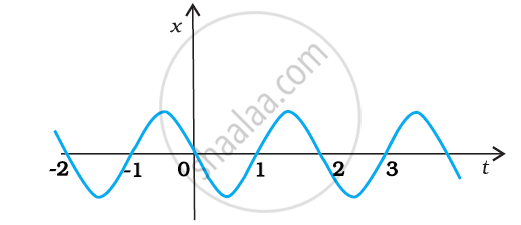
The following figure gives the x-t plot of a particle executing one-dimensional simple harmonic motion. Give the signs of position, velocity and acceleration variables of the particle at t = 0.3 s, 1.2 s, – 1.2 s.
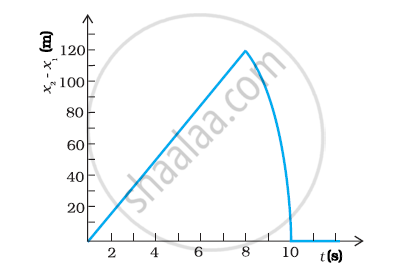
Two stones are thrown up simultaneously from the edge of a cliff 200 m high with initial speeds of 15 m/s and 30 m/s. Verify that the graph shown in Fig. 3.27 correctly represents the time variation of the relative position of the second stone with respect to the first. Neglect air resistance and assume that the stones do not rebound after hitting the ground. Take g = 10 m/s2. Give the equations for the linear and curved parts of the plot.
Two bullets are fired simultaneously, horizontally and with different speeds from the same place. Which bullet will hit he ground first?
A train starts from rest and moves with a constant acceleration of 2.0 m/s2 for half a minute. The brakes are then applied and the train comes to rest in one minute. Find the position(s) of the train at half the maximum speed.
A police jeep is chasing a culprit going on a motorbike. The motorbike crosses a turning at a speed of 72 km/h. The jeep follows it at a speed of 90 km/h, crossing the turning ten seconds later than the bike. Assuming that they travel at constant speeds, how far from the turning will the jeep catch up with the bike?
A ball is projected vertically upward with a speed of 50 m/s. Find the speed at half the maximum height. Take g = 10 m/s2.
A ball is dropped from a balloon going up at a speed of 7 m/s. If the balloon was at a height 60 m at the time of dropping the ball, how long will the ball take in reaching the ground?
A stone is thrown vertically upward with a speed of 28 m/s. Find the maximum height reached by the stone.
A person sitting on the top of a tall building is dropping balls at regular intervals of one second. Find the positions of the 3rd, 4th and 5th ball when the 6th ball is being dropped.
An NCC parade is going at a uniform speed of 6 km/h through a place under a berry tree on which a bird is sitting at a height of 12.1 m. At a particular instant the bird drops a berry. Which cadet (give the distance from the tree at the instant) will receive the berry on his uniform?
A ball is dropped from a height of 5 m onto a sandy floor and penetrates the sand up to 10 cm before coming to rest. Find the retardation of the ball is sand assuming it to be uniform.
A popular game in Indian villages is goli which is played with small glass balls called golis. The goli of one player is situated at a distance of 2.0 m from the goli of the second player. This second player has to project his goli by keeping the thumb of the left hand at the place of his goli, holding the goli between his two middle fingers and making the throw. If the projected goli hits the goli of the first player, the second player wins. If the height from which the goli is projected is 19.6 cm from the ground and the goli is to be projected horizontally, with what speed should it be projected so that it directly hits the stationery goli without falling on the ground earlier?
A ball is projected from a point on the floor with a speed of 15 m/s at an angle of 60° with the horizontal. Will it hit a vertical wall 5 m away from the point of projection and perpendicular to the plane of projection without hitting the floor? Will the answer differ if the wall is 22 m away?
A bomb is dropped from a plane flying horizontally with uniform speed. Show that the bomb will explode vertically below the plane. Is the statement true if the plane flies with uniform speed but not horizontally?
A person is standing on a truck moving with a constant velocity of 14.7 m/s on a horizontal road. The man throws a ball in such a way that it returns to the truck after the truck has moved 58.8 m. Find the speed and the angle of projection as seen from the truck .
Two friends A and B are standing a distance x apart in an open field and wind is blowing from A to B. A beat a drum and B hears the sound t1 time after he sees the event. A and B interchange their positions and the experiment is repeated. This time B hears the drum timer after he sees the event. Calculate the velocity of sound in still air v and the velocity of wind u. Neglect the time light takes in travelling between the friends.
Suppose A and B in the previous problem change their positions in such a way that the line joining them becomes perpendicular to the direction of wind while maintaining the separation x. What will be the time B finds between seeing and hearing the drum beating by A?
