Advertisements
Advertisements
प्रश्न
In which of the following cases more electrical energy is consumed per hour?
(i) A current of 1 ampere passed through a resistance of 300 ohms.
(ii) A current of 2 amperes passed through a resistance of 100 ohms.
Advertisements
उत्तर
(i) I = 1 A
R = 300 Î
t = 1 h
Electrical energy consumed = `I^2xxRxxt`
= (1)2 (300) (1)
= 300 Wh
(ii) I = 2 A
R = 100 Î
Electrical energy consumed = `I^2xxRxxt=(2)^2(100)(1)=400Wh`
Thus, more electrical energy is consumed in case (ii).
APPEARS IN
संबंधित प्रश्न
In 10 s, charge of 25 C leaves a battery, and 200 J of energy are delivered to an outside circuit a result.
What current flows from the battery?
A battery of 9 V is connected in series with resistors of 0.2 Ω, 0.3 Ω, 0.4 Ω, 0.5 Ω and 12 Ω. How much current would flow through the 12 Ω resistor?
An electric bulb of resistance 20 Ω and a resistance wire of 4 Ω are connected in series with a 6 V battery.
Draw the circuit diagram, and calculate:
(a) total resistance of the circuit.
(b) current through the circuit.
(c) potential difference across the electric bulb.
(d) potential difference across the resistance wire.
Ten bulbs are connected in a series circuit to a power supply line. Ten identical bulbs are connected in a parallel circuit to an identical power supply line.
- Which circuit would have the highest voltage across each bulb?
- In which circuit would the bulbs be brighter?
- In which circuit, if one bulb blows out, all others will stop glowing?
- Which circuit would have less current in it?
Ten bulbs are connected in a series circuit to a power supply line. Ten identical bulbs are connected in a parallel circuit to an identical power supply line.
(d) Which circuit would have less current in it?
How does the heat H produced by a current passing through a fixed resistance wire depend on magnitude of current I?
Calculate the equivalent resistance between A and B in the adjacent diagram.
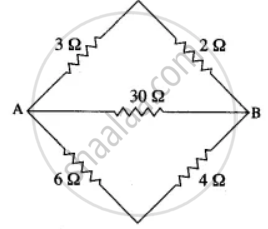
A 720 W heater operates from a 220 V line voltage. Calculate:
(a) The electrical energy consumed by the heater in 3 h.
(b) The cost of electrical energy consumption at the rate of 60 paise per kWh.
Define the following:
Super conductors
The following appliances are to be used on 240 V supply. Calculate the current used by each and say which fuse, 2 amp, 5 amp or 13 amp should be incorporated with each, (i) A television rated at 150 W, (ii) An electric iron rated at 750 W, (iii) An immersion heater rated at 3000 W, (iv) A hair dryer rated at 500 W. How much will it cost to run the television set for 100 days for an average of 4 hours a day at 60 paise per unit?
Tick (✓) the correct choice among the following :
Which of the following changes would enable a millimeter to be used as a
direct current ammeter reading upto 1 A?
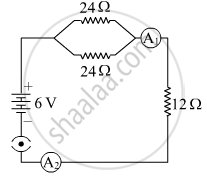
Study the following circuit and find out:
(i) Current in 12 Ω resistor.
(ii) The difference in the readings of A1 and A2, if any.
Match the items in column-I to the items in column-II:
| Column - I | Column - II |
| (i) electric current | (a) volt |
| (ii) potential difference | (b) ohm meter |
| (iii) specific resistance | (c) watt |
| (iv) Electrical power | (d) joule |
| (v) electrical energy | (e) ampere |
Which of the following correctly represents the formula for electric current?
The number of electrons required to produce a total charge of 1.6 C is:
