Advertisements
Advertisements
प्रश्न
In the given figure, ΔPQR is right-angled at P. PABQ and QRST are squares on the side PQ and hypotenuse QR. If PN ⊥ TS, show that:
(a) ΔQRB ≅ ΔPQT
(b) Area of square PABQ = area of rectangle QTNM.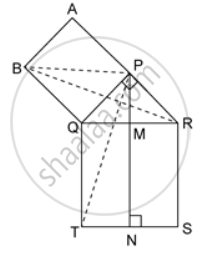
Advertisements
उत्तर
∠BQR = ∠BQP + ∠PQR
⇒ ∠BQR = 90° + ∠PQR
∠PQT = ∠TQR + ∠PQR
⇒ ∠PQT = 90° + ∠PQR ....(i)
⇒ ∠BQR = ∠PQT
(a) In ΔQRB and ΔPQT,
BQ = PQ ....(sides of a square PABQ)
QR = QT ....(sides of a square QRST)
∠BQR = ∠PQT ...[From (i)]
∴ ΔQRB ≅ ΔPQT ...(by SAS congruence criterion)
⇒ A(ΔBQR) = A(ΔPQT) ....(ii)
(b) ΔPQT and rect. QTNM are on the same base QT
and between the same parallel lines QT and PN.
∴ A(ΔPQT) = `(1)/(2)"A"("rect. QTNM")`
⇒ A(rect. QTMN) = x A(ΔPQT)
⇒ A(rect. QTMN) = x ar(ΔBQR) [From (ii)]....(iii)
ΔBQR and sq. PABQ are on the same base BQ
and between the same parallel lines BQ and AR.
∴ 2 x A(ΔBQR) = A(sq. PABQ) ....(iv)
From (i) and (iv),
A(sq. PABQ) = A(rect. QTNM)
