हिंदी

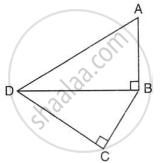
In the given figure, AD = 13 cm, DC = 12 cm and BC = 3 cm, then AB is equal to:

Advertisements
Advertisements

प्रश्न

In the given figure, AD = 13 cm, DC = 12 cm and BC = 3 cm, then AB is equal to:
विकल्प

  • 4 cm

  • 3 cm

  • 5 cm

  • 6 cm

MCQ
Advertisements

उत्तर

4 cm

Explanation:

In right-angled ΔDCB, applying Pythagoras’ theorem gives:

DB2 = DC2 + BC2 = 122 + 32 = 153.

In right-angled ΔABD, we have:

AB2 = AD2 − DB2 = 132 − 153 = 16,

which yields AB = 4 cm.

shaalaa.com
  क्या इस प्रश्न या उत्तर में कोई त्रुटि है?
अध्याय 12: Pythagoras Theorem [Proof and Simple Applications with Converse] - Exercise 12 (A) [पृष्ठ १७९]

APPEARS IN

सेलिना Concise Mathematics [English] Class 9 ICSE
अध्याय 12 Pythagoras Theorem [Proof and Simple Applications with Converse]
Exercise 12 (A) | Q 1. (e) | पृष्ठ १७९
Share
Notifications

Englishहिंदीमराठी


      Forgot password?
Use app×