Advertisements
Advertisements
प्रश्न
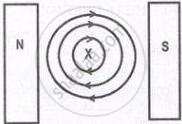
In the given diagram, X represents a conductor carrying current into the plane of the paper and kept in a magnetic field. N and S represent the poles of a magnet and the concentric circles of the magnetic field produced by the conductor.
- State the direction of the force experienced by the conductor.
- Explain the cause of the above-said force.
- Name the law used to determine the direction of the force in the conductor.
दीर्घउत्तर
Advertisements
उत्तर
- In the given diagram, the force on the conductor acts vertically downwards, i.e. perpendicular to both the direction of current and the magnetic field.
- A current-carrying conductor produces its own magnetic field around it. This field interacts with the magnetic field of the magnet. On one side of the conductor the fields are in the same direction, so the magnetic field becomes stronger; on the other side they are opposite, so the field becomes weaker. This causes a net force on the conductor.
- Fleming's left-hand rule.
shaalaa.com
क्या इस प्रश्न या उत्तर में कोई त्रुटि है?
