Advertisements
Advertisements
प्रश्न
In the following figure, points A, B, C, D and E are collinear such that AB = BC = CD = DE. Then

AE = ______ × AB.
Advertisements
उत्तर
In the following figure, points A, B, C, D and E are collinear such that AB = BC = CD = DE. Then

AE = 4 × AB.
Explanation:
∵ AB + BC + CD + DE = AE
⇒ AB + AB + AB + AB = AE
∴ 4AB = AE
APPEARS IN
संबंधित प्रश्न
In the following figure, points A, B, C, D and E are collinear such that AB = BC = CD = DE. Then

AD = AB + ______
In the following figure, points A, B, C, D and E are collinear such that AB = BC = CD = DE. Then

Mid point of AE is ______
The number of common points in the two angles marked in the following figure is ______.

The number of common points in the two angles marked in the following figure ______.

Look at a given figure. Mark a point
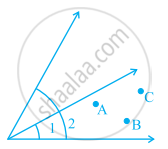
- A which is in the interior of both ∠1 and ∠2.
- B which is in the interior of only ∠1.
- Point C in the interior of ∠1.
Now, state whether points B and C lie in the interior of ∠2 also.
In the following figure, is AB + BC = CA?

How many points are marked in the following figure?

Draw a rough figure and label it suitably in the following case:
Point P lies on `overline"AB"`.
A point has:
A point is usually denoted by:
