Advertisements
Advertisements
प्रश्न
In the following figure, area of ΔPQR is 20 cm2 and area of ΔPQS is 44 cm2. Find the length RS, if PQ is perpendicular to QS and QR is 5 cm.

Advertisements
उत्तर
Given, area of ΔPQR = 20 cm2 and area of ΔPQS = 44 cm2
We know that,
Area of triangle = `1/2` × Base × Height
∴ Area of ΔPQR = `1/2` × PQ × QR ...[∵ PQ ⊥ QR]
⇒ 20 = `1/2` × PQ × 5
⇒ `(20 xx 2)/5` = PQ ...[∵ QR = 5 cm, given]
⇒ PQ = 8 cm
∴ Area of ΔPQS = `1/2` × PQ × QS
⇒ 44 = `1/2` × 8 × QS
⇒ QS = `(44 xx 2)/8` ...[∵ PQ = 8 cm]
⇒ QS = 11 cm
Now, RS = QS – QR = 11 – 5 = 6 cm
APPEARS IN
संबंधित प्रश्न
Find the values of k so that the area of the triangle with vertices (1, -1), (-4, 2k) and (-k, -5) is 24 sq. units.
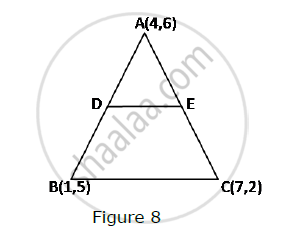
In Fig. 8, the vertices of ΔABC are A(4, 6), B(1, 5) and C(7, 2). A line-segment DE is drawn to intersect the sides AB and AC at D and E respectively such that `(AD)/(AB)=(AE)/(AC)=1/3 `Calculate th area of ADE and compare it with area of ΔABCe.
Show that the following sets of points are collinear.
(1, −1), (2, 1) and (4, 5)
Prove that the points (2, 3), (-4, -6) and `(1, 3/2)` do not form a triangle.
Show that the following points are collinear:
A(–5, 1), B(5, 5) and C(10, 7)
Show that the following points are collinear:
A(8, 1), B(3, –4) and C(2, –5)
If the co-ordinates of the vertices of an equilateral triangle with sides of length ‘a’ are (x1, y1), (x2, y2), (x3, y3), then `|(x_1, y_1, 1),(x_2, y_2, 1),(x_3, y_3, 1)|^2 = (3"a"^4)/4`
Points A(–6, 10), B(–4, 6) and C(3, –8) are collinear such that AB = `2/9` AC.
Find the value of m if the points (5, 1), (–2, –3) and (8, 2m) are collinear.
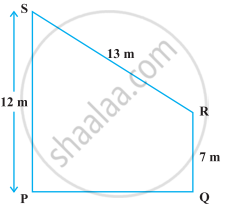
Find the area of the trapezium PQRS with height PQ given in the following figure.