Advertisements
Advertisements
प्रश्न
In problems 1 – 6, using the table estimate the value of the limit.
`lim_(x -> 2) (x - 2)/(x^2 - x - 2)`
| x | 1.9 | 1.99 | 1.999 | 2.001 | 2.01 | 2.1 |
| f(x) | 0.344820 | 0.33444 | 0.33344 | 0.333222 | 0.33222 | 0.332258 |
Advertisements
उत्तर
`lim_(x -> 2) (x - 2)/(x^2 - x - 2) = lim_(x -> 2) ( x - 2)/((x - 2)(x + 1))`
= `lim_(x -> 2) (x - 2)/(x + 1)`
| x | 1.9 | 1.99 | 1.999 | 2.001 | 20.1 | 2.1 |
| f(x) |
`1/(1.9 + 1)` = `1/2.9` = 0.34 |
`1/(1.99 + 1)` = `1/2.99` = 0.33 |
`1/(1.999 + 1)` = `1/2.99` = 0.33 |
`1/(2.001 + 1)` = `1/3.001` = 0.33 |
`1/(2.01 + 1)` = `1/3.01` = 0.33 |
`1/(2.1 + 1)` = `1/3.1` = 0.32 |
`lim_(x -> 2) (x - 2)/(x^2 - x - 2)` = 0.3
APPEARS IN
संबंधित प्रश्न
Evaluate the following limit:
If `lim_(x -> 1)[(x^4 - 1)/(x - 1)]` = `lim_(x -> "a")[(x^3 - "a"^3)/(x - "a")]`, find all possible values of a
Evaluate the following limit :
`lim_(x -> 7) [(x^3 - 343)/(sqrt(x) - sqrt(7))]`
In the following example, given ∈ > 0, find a δ > 0 such that whenever, |x – a| < δ, we must have |f(x) – l| < ∈.
`lim_(x -> -3) (3x + 2)` = – 7
In the following example, given ∈ > 0, find a δ > 0 such that whenever, |x – a| < δ, we must have |f(x) – l| < ∈.
`lim_(x -> 1) (x^2 + x + 1)` = 3
Evaluate the following :
`lim_(x -> 1) [(x + 3x^2 + 5x^3 + ... + (2"n" - 1)x^"n" - "n"^2)/(x - 1)]`
In exercise problems 7 – 15, use the graph to find the limits (if it exists). If the limit does not exist, explain why?
`lim_(x -> 1) (x^2 + 2)`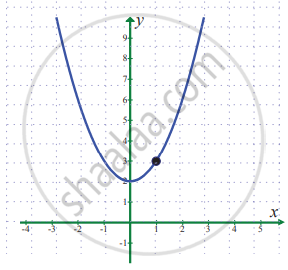
In exercise problems 7 – 15, use the graph to find the limits (if it exists). If the limit does not exist, explain why?
`lim_(x -> 2) f(x)` where `f(x) = {{:(4 - x",", x ≠ 2),(0",", x = 2):}`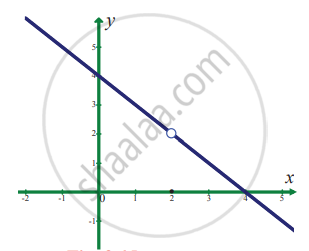
Sketch the graph of f, then identify the values of x0 for which `lim_(x -> x_0)` f(x) exists.
f(x) = `{{:(sin x",", x < 0),(1 - cos x",", 0 ≤ x ≤ pi),(cos x",", x > pi):}`
If f(2) = 4, can you conclude anything about the limit of f(x) as x approaches 2?
If the limit of f(x) as x approaches 2 is 4, can you conclude anything about f(2)? Explain reasoning
Evaluate : `lim_(x -> 3) (x^2 - 9)/(x - 3)` if it exists by finding `f(3^-)` and `f(3^+)`
Evaluate the following limits:
`lim_("h" -> 0) (sqrt(x + "h") - sqrt(x))/"h", x > 0`
Evaluate the following limits:
`lim_(x -> 1) (root(3)(7 + x^3) - sqrt(3 + x^2))/(x - 1)`
Evaluate the following limits:
`lim_(x - 0) (sqrt(1 + x^2) - 1)/x`
An important problem in fishery science is to estimate the number of fish presently spawning in streams and use this information to predict the number of mature fish or “recruits” that will return to the rivers during the reproductive period. If S is the number of spawners and R the number of recruits, “Beverton-Holt spawner recruit function” is R(S) = `"S"/((alpha"S" + beta)` where `alpha` and `beta` are positive constants. Show that this function predicts approximately constant recruitment when the number of spawners is sufficiently large
Evaluate the following limits:
`lim_(x -> 0) (2^x - 3^x)/x`
Evaluate the following limits:
`lim_(x -> ) (sinx(1 - cosx))/x^3`
Choose the correct alternative:
`lim_(x -> 0) sqrt(1 - cos 2x)/x`
`lim_(x→-1) (x^3 - 2x - 1)/(x^5 - 2x - 1)` = ______.
