Advertisements
Advertisements
प्रश्न
In problems 1 – 6, using the table estimate the value of the limit
`lim_(x -> 0) (sqrt(x + 3) - sqrt(3))/x`
| x | – 0.1 | – 0.01 | – 0.001 | 0.001 | 0.01 | 0.1 |
| f(x) | 0.2911 | 0.2891 | 0.2886 | 0.2886 | 0.2885 | 0.28631 |
Advertisements
उत्तर
Let f(x) = `lim_(x -> 0) (sqrt(x + 3) - sqrt(3))/x`
| x | – 0.1 | – 0.01 | – 0.001 | 0.001 | 0.01 | 0.1 |
| f(x) |
`(sqrt(3 - 0.1) - sqrt(3))/(- 0.1)` = `(1.703 - 1.732)/(- 0.1)` = 0.29 |
`(sqrt(3 - 00.1) - sqrt(3))/(- 0.01)` = `(1.703 - 1.732)/(- 0.01)` = 0.288 |
`(sqrt(3 - 0.001) - sqrt(3))/(- 0.001)` = `(0.000284)/(- 0.001)` = 0.288 |
`(sqrt(3 + 0.001) - sqrt(3))/(- 0.001)` = `(0.000289)/(0.001)` = 0.289 |
`(sqrt(3 + 0.01) - sqrt(3))/(0.01)` = `(0.00288)/(0.01)` = 0.288 |
`(sqrt(3 + 0.1) - sqrt(3))/(0.1)` = `(0.0286)/(0.1)` = 0.286 |
`lim_(x -> 0) (sqrt(x + 3) - sqrt(3))/x` = 0.288
APPEARS IN
संबंधित प्रश्न
Evaluate the following limit :
`lim_(y -> 1)[(2y - 2)/(root(3)(7 + y) - 2)]`
In the following example, given ∈ > 0, find a δ > 0 such that whenever, |x – a| < δ, we must have |f(x) – l| < ∈.
`lim_(x -> -3) (3x + 2)` = – 7
In exercise problems 7 – 15, use the graph to find the limits (if it exists). If the limit does not exist, explain why?
`lim_(x -> 3) 1/(x - 3)`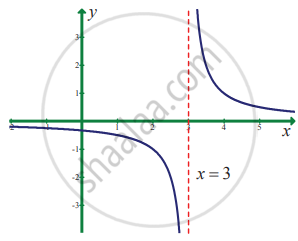
Sketch the graph of a function f that satisfies the given value:
f(– 2) = 0
f(2) = 0
`lim_(x -> 2) f(x)` = 0
`lim_(x -> 2) f(x)` does not exist.
If the limit of f(x) as x approaches 2 is 4, can you conclude anything about f(2)? Explain reasoning
Evaluate the following limits:
`lim_(sqrt(x) -> 3) (x^2 - 81)/(sqrt(x) - 3)`
Evaluate the following limits:
`lim_(x -> 5) (sqrt(x + 4) - 3)/(x - 5)`
Evaluate the following limits:
`lim_(x -> 1) (sqrt(x) - x^2)/(1 - sqrt(x))`
Evaluate the following limits:
`lim_(x - 0) (sqrt(1 + x^2) - 1)/x`
Find the left and right limits of f(x) = tan x at x = `pi/2`
Evaluate the following limits:
`lim_(x -> oo) ((2x^2 + 3)/(2x^2 + 5))^(8x^2 + 3)`
Evaluate the following limits:
`lim_(x -> 0) (sqrt(x^2 + "a"^2) - "a")/(sqrt(x^2 + "b"^2) - "b")`
Evaluate the following limits:
`lim_(x-> 0) (1 - cos x)/x^2`
Evaluate the following limits:
`lim_(x -> pi) (1 + sinx)^(2"cosec"x)`
Evaluate the following limits:
`lim_(x -> 0) (sqrt(1 + sinx) - sqrt(1 - sinx))/tanx`
Evaluate the following limits:
`lim_(x -> 0) (tan x - sin x)/x^3`
Choose the correct alternative:
`lim_(x - pi/2) (2x - pi)/cos x`
If f(x) is differentiable at x = 1 and `lim_(h → 0) 1/h f(1 + h) = 5`, then f' (1) is equal to ______.
