Advertisements
Advertisements
प्रश्न
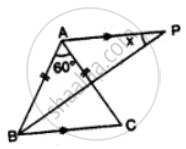
In Figure, BP bisects ∠ABC and AB = AC. Find x.
Advertisements
उत्तर
In the figure,
AB = AC, and BP bisects ∠ABC
AP || BC is drawn.
Now ∠PBC = ∠PBA .........(∵ PB is the bisector of ∠ABC)
∵ AP || BC
∴ ∠APB = ∠PBC ............(Alternate angles)
⇒ x = ∠PBC ..................(i)
In Δ ABC, ∠A = 60°
and ∠B = ∠C ...................(∵ AB = AC)
But ∠A + ∠B + ∠C = 180°.....................(Angles of a triangle)
⇒ 60° + ∠B + ∠C = 180°
⇒ 60° + ∠B + ∠B = 180°
⇒ 2 ∠B = 180° − 60° = 120°
∴ ∠B =`(120°)/2=60°`
⇒ `1/2∠"B"=(60°)/2=30°`
⇒ ∠PBC = 30°
∴ From (i),
x = 30°
APPEARS IN
संबंधित प्रश्न
Find the unknown angles in the given figure:
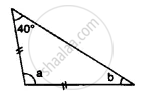
Apply the properties of isosceles and equilateral triangles to find the unknown angles in the given figure:
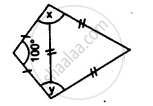
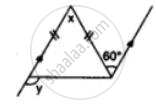
Find the unknown angles in the given figure:
In an isosceles triangle, each base angle is four times its vertical angle. Find all the angles of the triangle.
The vertical angle of an isosceles triangle is three times the sum of its base angles. Find each angle.
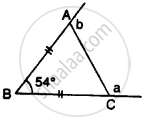
In ∆ ABC, BA and BC are produced. Find the angles a and h. if AB = BC.
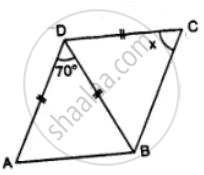
Find x in Figure Given: DA = DB = DC, BD bisects ∠ABC and∠ADB = 70°.
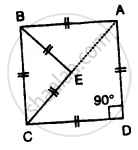
In the figure, given below, ABCD is a square, and ∆ BEC is an equilateral triangle. Find, the case:∠ABE
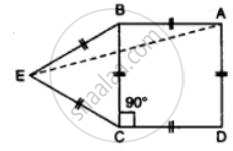
In the figure, given below, ABCD is a square, and ∆ BEC is an equilateral triangle. Find, the case:∠BAE
The angles of a triangle are in the ratio 1 : 2 : 3, find the measure of each angle of the triangle
